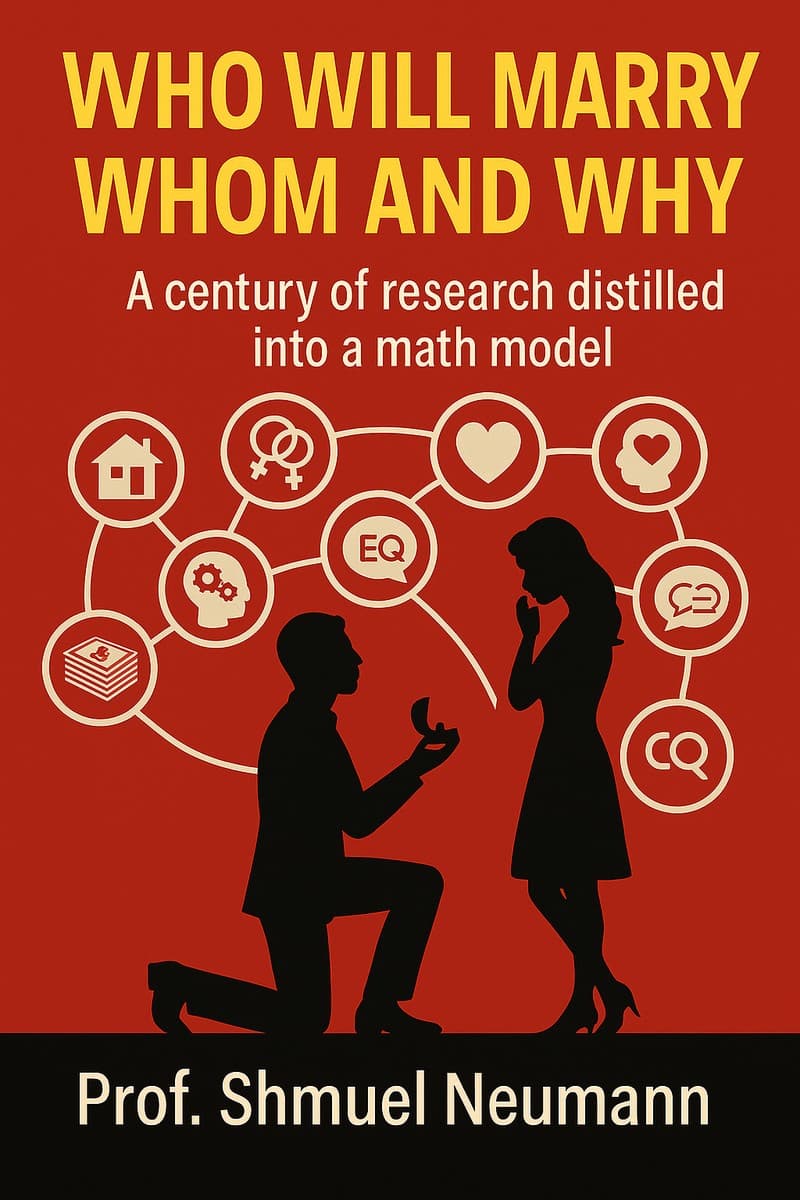
Who Marries Whom and Why
CRITICAL ACCLAIM
“Initial similarity on key dimensions—values, religious commitment, life goals—provides a foundation. But lasting, satisfying marriages are built through continuous mutual investment: developing communication skills, cultivating emotional attunement, maintaining physical and emotional intimacy, supporting each other through life's challenges, growing together rather than apart.”
Video Explainer
Audio Podcast
About This Book
Initial similarity on key dimensions—values, religious commitment, life goals—provides a foundation. But lasting, satisfying marriages are built through continuous mutual investment: developing communication skills, cultivating emotional attunement, maintaining physical and emotional intimacy, supporting each other through life’s challenges, growing together rather than apart. The couples who succeed are not necessarily those with the highest initial compatibility scores but those who commit to the ongoing work of building their relationship.
We began this book by acknowledging a paradox: that love feels free yet follows predictable patterns, that destiny and difficulty coexist in the search for a life mate. Having traced the empirical contours of human mate selection across nine chapters—examining demographic homogamy, value alignment, cognitive compatibility, personality dynamics, physical attraction, functional complementarity, cross-cultural variation, and mathematical modeling—we return to that paradox with deeper understanding.
The research synthesized in these pages reveals an extraordinary regularity in human pairing. Age correlations approaching 0.9. Educational and religious homogamy exceeding 0.5. Political ideology matching at levels comparable to religious alignment. Even physical attractiveness and intelligence show correlations that, while more modest, far exceed what random chance would produce. These patterns persist across cultures, historical periods, and social systems, from arranged marriages in traditional societies to autonomous choice in modern liberal democracies.
Yet for all this regularity, for all the variance explained by systematic variables, something profound remains unexplained. Even the most comprehensive models, integrating dozens of measured traits across tens of thousands of couples, account for at most 70% of the variance in who marries whom—and often far less when predicting long-term relationship quality. That remaining 30-50% is not noise to be eliminated with better measurement. It represents something essential about human connection that resists quantification: the chemistry that cannot be predicted from demographic profiles, the growth that occurs through mutual adaptation, the grace that sometimes transforms unpromising beginnings into extraordinary relationships.
This insight challenges the modern romantic narrative that finding “the one” is the essential task, after which happiness naturally follows. The research tells a different story: there are many potential mates with whom we could build successful marriages, and the crucial variable is not finding the perfect match but choosing a good-enough match and then making that relationship excellent through sustained effort. The destination relationship—the mature relationship characterized by mutual support, shared meaning, and lasting satisfaction—is not found but built.