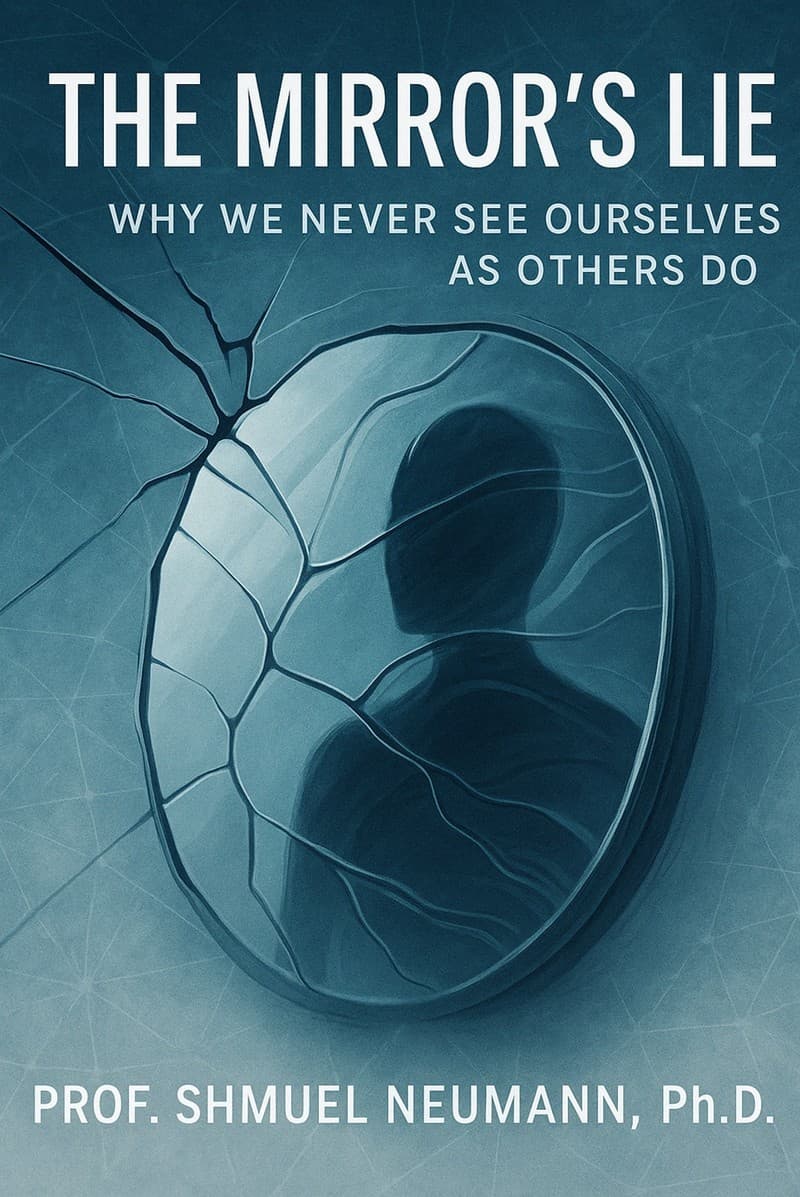
The Mirror's Lie
CRITICAL ACCLAIM
“This book confronts the root distortion behind insecurity, self-sabotage, and shame: a fractured sense of self. It blends Torah insight and therapeutic frameworks to rebuild the inner mirror. For those who can't believe the good they see—or receive.”
Video Explainer
Audio Podcast
About This Book
You’re not unlovable. You’re just looking at yourself through a broken lens. This book confronts the root distortion behind insecurity, self-sabotage, and shame: a fractured sense of self. It blends Torah insight and therapeutic frameworks to rebuild the inner mirror.
For those who can’t believe the good they see—or receive.
Acentury before the camera and a millennium before the selfie, a sixth‑century metalworker in Constantinople engraved a bronze basin so finely polished it reflected the face of its owner more faithfully than any stream. The chronicler who recorded the basin’s creation said people flocked to behold themselves “as if seeing a stranger in familiar skin.”¹ It is a striking phrase, because it hints at the core puzzle of this book: every mirror—no matter how perfect—shows only a silhouette of the person we carry inside.
This tension between inner self and outer image is older than psychology. It threads through the tale of Narcissus, whose fatal enchantment was not with himself but with a reflection he mistook for substance.² It echoes in the Delphic oracle’s charge to “know thyself,” an injunction Socrates famously adopted yet never fully fulfilled.³ And it reverberates in modern life each time a polished phone screen lights up with a photo we barely recognize as our own. We inhabit bodies and minds, yet we meet them—as the medieval traveler met that bronze basin—like curious onlookers staring at a partly comprehensible stranger.
What changes when the “mirror” is no longer a slab of metal or glass but the perceptions of friends, colleagues, algorithms, and global followers? The twenty‑first century has surrounded us with ever sharper lenses—MRI scanners inferring patterns of neural activation associated with intention, social media analytics scoring personality from a paragraph of prose, and corporate dashboards assigning us performance metrics in real time. Paradoxically, the more ways we invent to examine ourselves, the more elusive an accurate self‑portrait seems to become. Research finds that most of us live with at least a 30 percent gap between how we think we are seen and how we are, in fact, seen by others.⁴
In this funhouse maze our reflection warps for many reasons: ego, fear, culture, digital curation, and simple limits of introspection. Those warps matter. They steer career choices, shape marriages, trigger conflict, and even guide entire nations in selfdelusional policy. Yet distortion is not destiny. Throughout history small groups—monks in silent retreat, stoic philosophers keeping daily journals, indigenous elders teaching “two‑eyed seeing”—have devised practices to narrow the gap.⁵ Their lessons, amplified by contemporary neuroscience and behavioral science, suggest a thrilling possibility: that clearer self-perception is not an unreachable ideal but a trainable skill.
This book is therefore both diagnosis and doorway.
You think you know yourself—but the mirror lies.
The Mirror’s Lie is a bold, brilliant excavation of self-perception, exploring why we so rarely see ourselves as others do—and why it matters. With cutting-edge psychology, Torah insight, and unforgettable storytelling, Prof. Shmuel Neumann reveals how our minds warp our self-image through cognitive bias, emotional blind spots, cultural distortions, and digital performance.
From spotlight effect to self-justification, from the Dunning–Kruger trap to algorithmic identity curation, this book traces the funhouse of modern selfhood—and shows how we can escape. At once compassionate and confronting, it equips readers with practical strategies to bridge the gap between who they think they are and how they are truly seen.
If you’ve ever walked away from a conversation wondering, “Did I come off the way I meant to?”—this book is your mirror, your map, and your guide back to reality.
“The better you understand bias, the more humbling it becomes.” So writes Shmuel Neumann, cognitive psychologist in The Mirror’s Lie, a graceful and quietly startling book about the dissonance between who we believe we are and how others perceive us.
Drawing on his decades of research in metacognition and social perception, Neumann walks readers through the “funhouse mirror” of self-awareness, layer by layer: from confirmation bias and the spotlight effect to cultural identity scripts and Instagram filters. The result is not just a diagnostic manual for the modern ego, but a remarkably compassionate invitation to recalibrate the stories we tell about ourselves.
Where the book shines brightest is in its balance of accessibility and depth. Neumann weaves together fMRI studies, Rabbinic parables, and real-world anecdotes without dumbing down the science or sermonizing. One standout chapter, “The Feedback Paradox,” unpacks why we simultaneously crave and reject honest input—offering not just analysis, but practical strategies for receiving critique without defensiveness.
There are echoes of Kahneman’s Thinking, Fast and Slow here, and of Adam Grant’s Think Again, but Neumann’s tone is gentler, more introspective. His background in both neuroscience and spiritual study adds a contemplative richness that’s rare in psychology writing. And unlike so many books in the “self-awareness industrial complex,” The Mirror’s Lie resists the urge to promise transformation in 30 days or fewer.
Perhaps most striking is the book’s epilogue, which lingers long after reading: “Clarity is both surrender and liberation: surrender of illusion, liberation from its maintenance costs.” It’s a fitting summary of a book that urges us not to abandon our mirrors, but to polish them more carefully—and, crucially, to let others help.