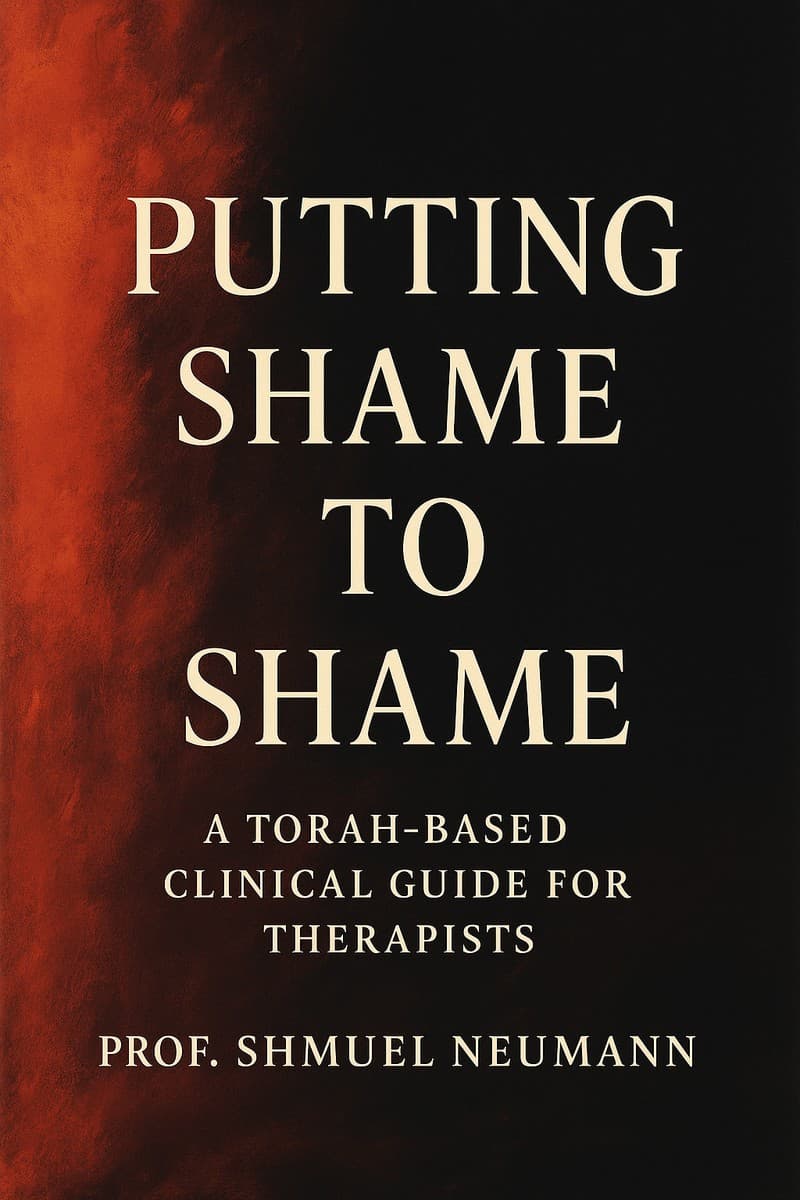
Putting Shame to Shame
CRITICAL ACCLAIM
“This book is not about getting rid of shame—it's about redeeming it. Drawing from the depths of Jewish theology, philosophy, and psychology, Prof. Shmuel Neumann offers a bold reframe: shame is not a pathology but a signal—calling us back to who we truly are. For seekers, thinkers, and those scarred by silence, this is a guide not to avoidance, but to transformation.”
Video Explainer
Audio Podcast
About This Book
Transforming shame from a spiritual wound into a sacred compass. This book is not about getting rid of shame—it’s about redeeming it. Drawing from the depths of Jewish theology, philosophy, and psychology, Prof. Shmuel Neumann offers a bold reframe: shame is not a pathology but a signal—calling us back to who we truly are. For seekers, thinkers, and those scarred by silence, this is a guide not to avoidance, but to transformation.
The pain we encounter is real. The damage, deep. But the tools of the Torah—teshuva, chesed, community, prayer, halachic structure, kedusha—these are not spiritual metaphors for emotional healing. They are the cure itself. Psychological methods may assist in navigating the terrain, but they are not the compass. Torah is.
This book, then, is not an invitation to balance two systems. It is a call to center one: the system of Torah, which has never failed us, never been updated, and never needed revision. In a world of shifting truths and therapeutic trends, we return to Sinai—not for sentiment, but for salvation.
The mission of this guide is not to merge Torah with psychology, but to anchor healing in emet. Where psychology aligns with Torah, it can serve as an instrument. Where it deviates, it must be discarded. We do not bend the pasuk to fit the protocol. We do not reinterpret the halacha to accommodate therapeutic theory. Torah is not therapy. It is reality.
And yet, the Torah does not fear psychology. It has no need to. Truth does not fear investigation. What we seek here is not synthesis but submission—the careful calibration of psychological technique under the rulership of Torah hashkafa, halacha, and the moral clarity of Chazal.
May our work in the world of healing reflect not our cleverness, but our allegiance. May it be an extension of Torah, not a negotiation with it. And may all who seek to heal know that true healing begins when the soul is returned to its Source—and all other tools take their rightful place beneath it.
There is a temptation in our generation to treat Torah and psychology as parallel truths—two equally valid systems that merely need better translation. But that is not the premise of this work, and it cannot be the conclusion.
Torah is not one wisdom among many. It is the blueprint of creation, the will of the Ribbono Shel Olam articulated in language, in halacha, and in the lived soul of Am Yisrael. Psychology, however helpful, is a human attempt to map that which Torah already defines. It may offer tools, lenses, and language—but it does not possess ultimate authority. It shifts. It revises. It contradicts itself every generation. Torah does not.