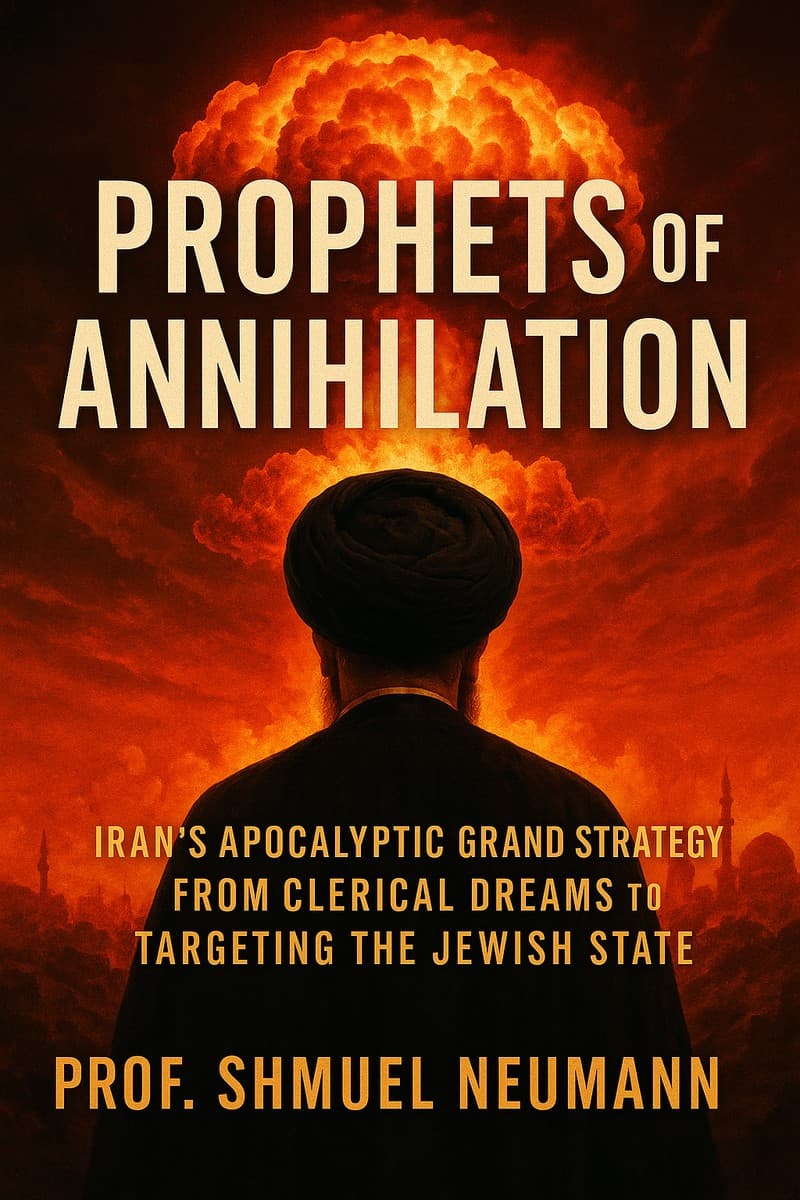
Prophets of Annihilation
CRITICAL ACCLAIM
“A chilling expose of how extremist religious ideologies weaponize prophecy to justify mass destruction. With surgical precision, Neumann dissects the belief systems fueling global terror, tracing their messianic roots and geopolitical ambitions. For policy analysts, faith leaders, and anyone who still thinks nukes are just about politics—this is required reading.”
Video Explainer
Audio Podcast
About This Book
When theology demands the apocalypse, the missiles are already loaded.
A chilling expose of how extremist religious ideologies weaponize prophecy to justify mass destruction. With surgical precision, Neumann dissects the belief systems fueling global terror, tracing their messianic roots and geopolitical ambitions. For policy analysts, faith leaders, and anyone who still thinks nukes are just about politics—this is required reading.
In a world increasingly drawn to comfort and control, The Pleasure of Danger dares to explore the sacred thrill that pulses just beneath the surface of risk. This provocative book is a neurotheological exploration of why some people come alive on the edge—where fear, freedom, and ecstasy converge. Far from dismissing these individuals as reckless or unstable, the author dives into the biochemistry and spiritual yearning behind adrenaline-driven behavior. He reveals how what looks like danger-seeking is often the soul’s craving for immediacy, intensity, and meaning.
Through deeply researched neuroscience and case-based insights, the book shows how the brain responds to danger not just as threat, but as a kind of invitation. The dopamine surge, the narrowing of attention, the heightened awareness of time—these are not merely physiological responses; they are states of grace for those who live on the edge of collapse. For many, thrill-seeking is not about escape—it’s about coming home to the rawness of existence, where every second counts and the noise of the mundane world falls away.
But the story doesn’t stop at biology. Drawing on Jewish mystical sources, Prof. Shmuel Neumann reframes this drive for danger as a form of spiritual seeking. The attraction to danger becomes a metaphor for the human need to confront the infinite, to feel alive in a world dulled by routine. Torah, Kabbalah, and Hasidic teachings intertwine with modern psychology to show that the hunger for risk is not a flaw to be extinguished—it’s a force to be sanctified.
The Pleasure of Danger is not a manual for safe living. It’s a mirror held up to those who’ve always felt a fire where others feel fear. It affirms that the longing for danger is, at its root, a longing for transcendence—and that the answer to that longing lies not in denial or shame, but in harnessing it for holy purpose.
Iran’s nuclear program has entered a phase of strategic sophistication that rivals anything seen in the modern era—these are advanced moves worthy of world-class chess players. Fordow, their underground enrichment facility, is buried 80 to 100 meters beneath dense mountain rock, shielded by reinforced concrete, blast-diffusing cavities, and shock-absorbing tunnel designs. Even the U.S.’s most powerful conventional bunker buster—the GBU-57A/B MOP—can only penetrate about 25 to 30 meters into hard granite, nowhere near Fordow’s critical infrastructure. Physics—not politics—makes this site untouchable.
At the same time, Iran has enriched uranium to 60%, which is already 85% of the way to weapons-grade. From there, it’s a short sprint measured in weeks, not months—especially with IR-6 centrifuges operating at high output. The program is modular and redundant, distributed across hardened, concealed facilities, making it impossible to take down with a single strike. Nuclear materials can be moved in small, shielded containers using standard vehicles, and everything is built to blend into civilian infrastructure.
And while the physical defenses are formidable, the informational warfare is just as precise. Iran floods the media space with calibrated narratives to manage global perception and constrain Israeli or Western responses. Every part of this system—from the engineering beneath the mountains to the headlines above—is part of a coordinated strategy. This isn’t just a nuclear program. It’s a playbook of brilliance, executed like a master playing ten opponents at once.
Only one lever remains: credible, overwhelming, ever-visible deterrence—an unambiguous demonstration that pressing the launch key guarantees not paradise but an Iranian void so total that even the Mahdi would find no nation left to redeem.
Call it bleak; call it tragic. It is, instead, the sole arithmetic that registers inside a theology of ashes.
The choice, then, is binary and brutal:
Either stand ready to erase the erasers—or prepare to be erased alongside them.
History has reached its fork. Talking time is over. What happens next is measured not in words but in megatons, cyber-loops, and the steadiness of the hands that must hold them.
May those hands choose deterrence before dust.