On the first Friday afternoon after their wedding, the apartment is still half-camp and half-home. Cardboard boxes lean against the wall like unfinished sentences. There is a small table, borrowed chairs, a pot that doesn't quite match its lid. They think they are preparing for Shabbos. What they are actually doing — without language for it yet — is nesting: the slow conversion of two nervous systems into a shared place of safety.
The apartment will come together. The routines will settle. And somewhere in that process of becoming invisible — if nobody is paying attention — something else disappears too.
A marriage needs to produce two emotional states. Not a balance between them. Both of them, fully, at the same time. And they are genuine opposites.
The first is the feeling of safety. The body-level certainty that this person will not disappear when things are hard. That you can be depleted, frightened, at your worst, and the relationship will hold. Your shoulders drop. Something in the nervous system that has been braced since before you had words for bracing finally, in this person's presence, lets go. Forty years of attachment research trace this to the deepest layer of human bonding — the same system that keeps an infant alive and orients the adult toward one person as the primary source of comfort under stress.[1] Safety is the foundation. Without it, nothing real can be built.
The second is not merely aliveness. It is exhilaration. Thrill. The electric charge of a situation the nervous system reads as slightly dangerous. The pulse that doesn't just quicken — it pounds. The vertigo of not knowing what he will do next, and finding that uncertainty intoxicating rather than frightening. The sense that this person is genuinely unpredictable, that he could walk out, that he doesn't need her quite as much as she needs him, that the outcome is not guaranteed — and that all of this, somehow, makes the pull stronger rather than weaker. This is the state that drives women toward men everyone around them can see are wrong. Not because those women are naive. Because the nervous system is doing exactly what it was built to do. The thrill register and the danger register run on the same circuitry. The bad boy is not attractive despite the risk. He is attractive because of it.
The problem is that these two states are produced by opposite conditions — and the gap between them is not merely wide, it is structural. Safety comes from predictability, consistency, reliability. I know who you are. I know where you are. I know what to expect. The thrill comes from volatility, unpredictability, the edge of loss. I do not know what you will do next. You might not stay. The outcome is still open. The conditions that generate deep security are precisely the conditions that extinguish the thrill. A man who shows up reliably, communicates clearly, and never leaves her wondering — a man who is, in every meaningful sense, good — produces the first state completely and the second state not at all. And a woman's nervous system, if she has not been taught to understand what it is doing, will read his consistency as flatness and his devotion as weakness, and will feel more alive in five minutes with someone who makes her anxious than in a year with someone who makes her feel held.
Marital boredom measured at year seven predicts significantly lower satisfaction a decade later.[2] Not conflict. Not distance. Boredom. The quiet signal that the second state has gone permanently offline. The person is still there. The household is still functioning. But the thrill has drained out, and neither partner has the vocabulary to say so, and the distance accumulates. Emotional disengagement — not conflict, not incompatibility — is the primary predictor of divorce in Gottman's longitudinal research on thousands of couples.[3] Couples in conflict can repair. Couples who have gone quiet cannot, because there is no longer enough engagement to work with. The marriage dissolves not in a dramatic rupture but in a long, gradual withdrawal, until the withdrawal is the relationship.

In the broader population, this deficit is where infidelity begins. Affairs do not start in desire. They start in a spouse who stopped feeling the charge — who cannot remember the last time something felt urgent, electric, slightly dangerous.[4] The outside relationship offers the second state completely, overwhelmingly, unencumbered by twelve years of accumulated familiarity. The affair is not really about the other person. It is about the experience of the thrill returning — the vertigo of not knowing, the intoxication of being wanted by someone who hasn't yet decided. In a community where crossing that line is unthinkable, the dynamic does not disappear. It finds a different outlet. The text thread that carries a warmth the marriage stopped producing. The conversation at a Shabbos table that goes on a little longer than it should, with a little more attention than is necessary. Nothing is violated. And the emotional charge that belongs in the marriage is quietly flowing somewhere else.
The Torah knew this. "It is not good for man to be alone" is a creation-level act of empathy — a diagnosis that aloneness diminishes a human being, offered before the person who is alone has done anything wrong.[5] The tradition treats shalom bayis with extraordinary seriousness: the candle of the home takes halachic priority over other ritual goods because of the peace it produces,[6] and Hashem permits the erasure of His own name in water to restore peace between spouses.[7] But the Torah does not stop at peace.
Devarim states that a new husband is free at home for one year — exempt from military service, exempt from every civic obligation.[8] But the exemption is not the point. The exemption is the mechanism. The point is the commandment it creates space for: וְשִׂמַּח אֶת אִשְׁתּוֹ — he shall make his wife happy. The Sefer HaChinuch counts this among the taryag mitzvos: a positive commandment, binding.[9] Not to be present. Not to be faithful. To make her happy. The year is not a grace period before normal life begins. It is the formative template — the standard the Torah establishes for what a marriage is supposed to feel like before routine has a chance to calcify it. And the standard is not comfort. It is not security. It is joy: the active, daily, generated experience of a wife who feels chosen, delighted in, reached for. The Torah is not saying: spend a year getting settled before the real obligations start. It is saying that this is the real obligation, and that the first year is the model everything after is supposed to maintain. Not drift into safe and airless. Not settle into the quiet deadrock of a household that functions but does not thrill. Mishlei: rejoice with your wife, take delight in her love.[10] Koheles, which is not a sentimental book and does not traffic in wishful thinking, still commands: enjoy life with the woman you love.[11] The text does not resolve the tension between peace and joy. It commands the resolution.
The question is how. Because the conditions that produce each state seem to structurally rule out the other — and the answer cannot be watered down. The thrill the second state requires is real. It cannot be replaced by a pleasant date night or a weekend away. The nervous system is not fooled by manufactured novelty when the deeper signal — he might not stay, the outcome is open, I am not yet won — is absent.
What the second state actually responds to is not danger or unreliability in itself. It is the experience of being actively, urgently pursued — by someone who has other options, who does not need her to complete him, who reaches for her as a choice rather than a default. The bad boy produces that signal accidentally, as a byproduct of his actual indifference. A husband can produce it deliberately, as an act of will. The difference is that the husband's pursuit lands inside a structure of total commitment — which means the nervous system eventually receives both signals simultaneously: he is not going anywhere, and he is still reaching for me. That combination — the certainty and the charge — is what the Torah is describing when it commands joy alongside peace. It is not a soft feeling. It is the full voltage of both states, held together.
This requires a husband who does not disappear into reliability. Who retains, even cultivates, the capacity to surprise, to pursue, to desire visibly and urgently — not because the marriage is uncertain, but precisely because it is certain. The pursuit means something when it is chosen freely inside permanence. Couples who participate regularly in genuinely novel experiences together — not just pleasant, but new to both, slightly outside the established script — show measurably higher relationship quality than couples who share only familiar routines.[12] Hedonic adaptation — the biological process by which positive experiences fade into ordinariness — is not a character flaw. It is a reality that demands a deliberate counterforce. That counterforce is not instability. It is chosen intensity: the gesture that was not required, the moment that becomes a meet-cute inside a marriage because someone decided it should, the look that says without words — I see you, I am not used to you, I would choose you again today.
An airless marriage does not begin when the honeymoon ends. It begins on the first date. The two states have to be present at the origin — not as a promise that one of them will eventually show up, not as a hope that safety will someday generate thrill or that thrill will eventually mature into safety, but both, simultaneously, already in motion from the first time they sit across from each other. The man who will still choose her urgently at year twelve is the man who already had that quality on date one. The woman who will still carry the capacity to thrill him at year twenty is not someone who acquired that quality later. You cannot marry into one state and wait for the other to develop. It does not develop. It was either there at the beginning or the marriage will spend decades quietly without it.
Of all the things that can go wrong in a marriage, disconnection is the worst. Not a combative marriage — that at least has fire, has two people who still feel something about each other, who are still present enough to fight. The marriage that has simply gone flat. Two people in the same house, going through the motions, present in body and absent in every other way. Koheles says that a bad woman is more bitter than death.[13] The Maharal explains: what makes her רעה — bad — is not cruelty, not combativeness. It is that she produces no connection.[14]
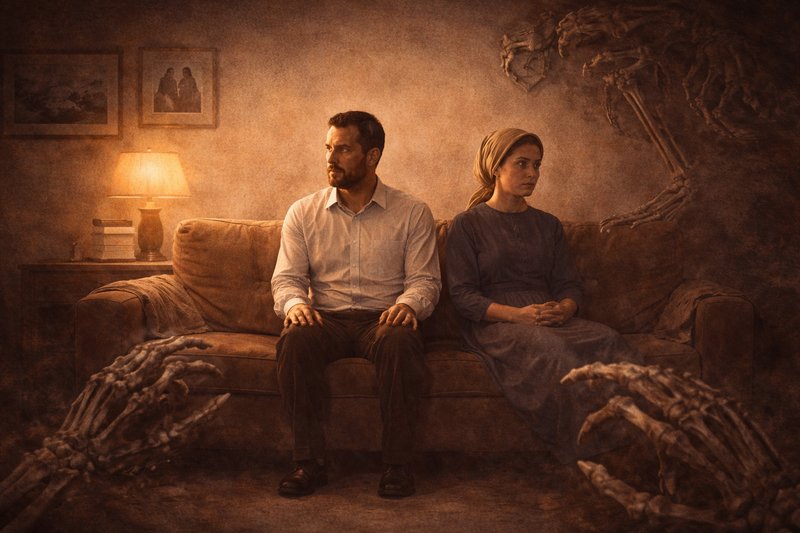
A lifeless marriage, in the Maharal's reading, is a worse fate than physical death. Death ends a life. A marriage with no connection continues one — hollowed out, day after day, two people sharing a house and a last name and nothing that reaches. The body lives. Everything else has already died. That is what Koheles calls more bitter than death. Not the fighting marriage. The empty one. But Judaism believes in תְּחִיַּת הַמֵּתִים — the resurrection of the dead.
Resurrect a lifeless marriage that is worse than death simply by choosing, today, to reach. Not by fixing what is broken. Not by a difficult conversation or a weekend away or a better version of what has already stopped working. By going back to the beginning. The apartment with the borrowed chairs. The first Shabbos. The two people who had not yet settled into each other, who were still capable of surprising each other, who had not yet made the mistake of thinking that safety was enough. Both states were alive then. They can be alive now. The security that says this person is not going anywhere — and the exhilaration that says I am still being chosen, still being reached for, still wanted with urgency by someone who could have settled and didn't. Both. Fully. That is not a fantasy about a different marriage. That is what this marriage was always supposed to be.

[1]John Bowlby, Attachment and Loss, 3 vols. (1969–1980); Cindy Hazan and Phillip Shaver, "Romantic Love Conceptualized as an Attachment Process," Journal of Personality and Social Psychology 52, no. 3 (1987): 511–524.
[2]Irene Tsapelas, Arthur Aron, and Terri Orbuch, "Marital Boredom Now Predicts Less Satisfaction 9 Years Later," Psychological Science 20, no. 5 (2009): 543–545.
[3]John Gottman and Robert Levenson, "A Two-Factor Model for Predicting When a Couple Will Divorce," Family Process 41 (2002): 83–96. Gottman's data consistently identifies emotional disengagement — what he terms the "Four Horsemen" giving way to a fifth stage of stonewalling and withdrawal — as the terminal pattern.
[4]Shirley Glass and Thomas Wright, "Justifications for Extramarital Relationships," Journal of Sex Research 29, no. 3 (1992): 361–387. Glass's research found that the majority of affairs begin in emotional disconnection rather than physical attraction, with the outside relationship supplying the experience of being chosen and seen.
[5]Bereishis 2:18.
[6]Shabbos 23b. The halacha that Shabbos candles take precedence over Chanukah candles is grounded in the principle of shalom bayis — the light of the home produces peace, and peace in the home is weighted above other mitzvos in this category.
[7]Sotah 17a. The Gemara states that Hashem permits His name — written in sanctity — to be erased in water to restore peace between a husband and wife.
[8]Devarim 24:5: "When a man takes a new wife, he shall not go out with the army and he shall not be charged with any matter; he shall be free at home one year and shall gladden his wife whom he has taken."
[9]Sefer HaChinuch, Mitzvah 582. The Chinuch enumerates the positive commandment incumbent on a new husband to bring joy to his wife during the first year of marriage.
[10]Mishlei 5:18.
[11]Koheles 9:9.
[12]Arthur Aron et al., "Couples' Shared Participation in Novel and Arousing Activities and Experienced Relationship Quality," Journal of Personality and Social Psychology 78, no. 2 (2000): 273–284.
[13]Koheles 7:26: "ומוצא אני מר ממות את האשה" — And I find more bitter than death the woman whose heart is snares and nets.
[14][Maharal, Chiddushei Aggados, Vol. 1, p. 139 (Yevamos 63b). On the Gemara's statement that an evil woman is compared to gehinnom, the Maharal writes: "האשה הרעה שהוא חיבור רע לגוף האדם והגיהנם הוא חבור רע אל הנשמה" — the bad wife is a bad union for the body of man, and gehinnom is a bad union for the soul. A bad wife is thus the bodily parallel to gehinnom: she does not complete him but diminishes him, his opposite rather than his fulfillment.