The Chesed L’Avraham describes a narrow path. After the neshamah departs this world, it walks a derech so thin that one misstep sends it into the darkness below. On both sides, dogs are barking.
They have always been barking. They barked before there were telephones, before there were intake forms and sixty-second pitches to someone’s mother. The path is ancient and the dogs are ancient and the choice is ancient: walk forward or stand still, and standing still is also falling.
A shadchan picks up the phone every morning and steps onto that path.
The dog behind them has a name. Its name is a question.
Rava teaches in Shabbos 31a: when a person departs from this world and is brought before the Beis Din shel Maalah for judgment, they are asked six questions.[1] Six questions put to every neshamah that has ever lived, standing in the world of emes, forced to testify against itself, unable to shade the truth because in that courtroom the neshamah cannot lie. Were your dealings honest. Did you set times for Torah. Did you await the redemption. Did you engage in the dialectics of wisdom. Did you understand one thing from another.
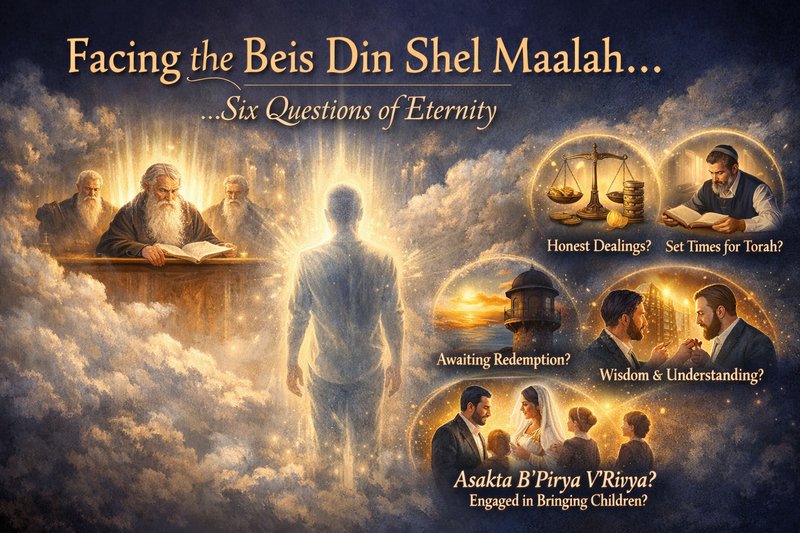
And the third question:
Asakta b’pirya v’rivya?
Did you busy yourself with bringing children into the world?
Not: did you succeed. Not: did you have children of your own. Asakta—were you occupied with it, did you invest yourself in it, did you treat the perpetuation of Klal Yisroel as your personal obligation or did you leave it to someone else because the work was hard or the hours were long or the cost was too high. The Beis Din shel Maalah does not ask whether the work bore fruit. It asks whether the work was done.
Matching a man and a woman is as difficult as splitting the Yam Suf.[2] Forty days before the formation of the child, a bas kol goes forth and declares: the daughter of this one is destined for that one.[3] The match already exists. It was decreed before either person drew breath. A shadchan’s work is to find it—to be the hands and the voice and the phone call through which a decree from shamayim becomes a Thursday night date at a hotel lobby in Brooklyn. The Gemara in Kesubos establishes that we are obligated to bring joy to a chosson and kallah—that even Torah study is set aside to dance before a bride.[4] R’ Shmuel bar Yitzchak used to dance before the bride, and when he died a pillar of fire separated him from everyone else—a distinction reserved for one or two people in a generation.[5] Fire from shamayim for a man who danced at weddings. That is how seriously the Torah takes the building of a Jewish home.
Being a shadchan is not a career. It is not a communal service. It is not a kindness performed when time permits. It is a divine imperative—one of the six questions every neshamah will face in the world of emes, standing naked before a tribunal that does not accept excuses. The person who could have made the call and did not will answer for every match that was never made.
And the person who makes the call is standing at the edge of Gehinnom.

R’ Chanina teaches: all who descend to Gehinnom ascend—except for three. One who commits adultery with a married woman. One who shames his fellow in public. One who calls his fellow by a derogatory name.[6] Three categories. Two are about feeling—about the way one person made another person feel about themselves. And the punishment is permanent. They descend and do not come back up. Gehinnom has an endpoint for everyone else in all of creation. For these three there is none.
R’ Elazar of Modi’in: one who shames another in public—hamalbin pnei chaveiro b’rabim—even if that person possesses Torah and good deeds, has no share in the World to Come.[7] Even if. Torah and good deeds and a lifetime of making matches and dancing at chuppos—all of it worthless. If the shadchan caused someone to feel that they are less than what they are.
Mar Zutra bar Tuvya: it is preferable for a person to throw himself into a fiery furnace rather than embarrass another person.[8] A fiery furnace. Physical death by fire. The Gemara says that is the lighter sentence.
The Sefer HaChinuch: ona’as devarim is defined by the pain caused, not by the intention behind it, and unlike monetary harm, it cannot be repaid or corrected.[9]
Rav: a man must always be careful about the ona’ah of his wife, for her tear comes easily, and retribution for ona’ah comes swiftly.[10] The Shulchan Aruch codifies: one must be especially careful about causing emotional pain to a woman.[11] Hashem punishes for ona’ah not through a shaliach. B’Yado. With His own hand.[12]
Dovid HaMelech: Simah dim’ati b’nodecha—place my tears in Your flask.[13] Every tear. Collected with the precision of someone who will use them as evidence. R’ Elazar: since the destruction of the Beis HaMikdash, the gates of prayer have been locked, but the gates of tears were never locked.[14] No gate. No intermediary. No delay. Straight to the Kisei HaKavod. Ima Shalom: all the gates of Heaven are locked except for the gates of ona’ah.[15]

Each tear counts and is counted.
A person walks into an intake meeting already carrying the weight of everything the system has done to them before they arrived—the self-doubt that started in front of a mirror, wondering whether their face was the right face, whether their family was the right family, whether their degree or their salary or their neighborhood added up to whatever invisible number separates the people who get suggested from the people who do not. The system taught them to measure themselves before the shadchan ever met them. And the measurements always came up short, because the system was never measuring what matters. They sit down across the desk and the shadchan picks up a pen. Height. Weight. Age. Hashkafah, reduced to a word. Family background, reduced to a sentence. A lifetime of becoming a person compressed into four lines that will be read to someone’s mother over the phone in sixty seconds. They came in as a person. They left as a paragraph. And the paragraph got forwarded. And they drove home.
If that paragraph—if the experience of being compressed into that paragraph—caused them pain, a tear entered the flask. The shadchan was doing their job. The tear entered the flask anyway.
The suggestions start. A shadchan looks at two profiles, sees a surface-level overlap—same age range, same hashkafah, both listed as “ready”—and makes the call. Maybe it was ninety seconds between two other calls, because there are seventy people and the day has only so many hours. The person on the other end hears the name and knows immediately that nobody listened. That nobody read the profile. That nobody spent more than a minute considering whether this could work. They say no to something that makes no sense and the shadchan tells them to give it a chance. They say yes against their own judgment because saying no means being called difficult. The date goes nowhere. The emotional cost of opening yourself to a stranger you already knew was wrong is charged to nobody’s account except the person who paid it. The shadchan has moved on to the next name.
If being told to give it a chance—being told that they know less about what they need than someone who read their file for ninety seconds—caused them pain, a tear entered the flask. The shadchan was trying to help. The tear entered the flask anyway.
Then the silence. Two weeks. Three weeks. The shadchan is overwhelmed—juggling seventy people, unpaid for most of this work, their own family pressing in. They have run out of hours. But the person who handed their hope to another human being and has not heard back does not experience the shadchan’s schedule. They experience the message that silence sends. You are not a priority. Your life—the one you are trying to build—is not urgent to the person who said they would help.
If that silence caused them pain, a tear entered the flask. The shadchan meant to call. The tear entered the flask anyway.
A shadchan says “I have someone for you” and the person walks into a hotel lobby carrying that recommendation like protection—the shadchan said this was good, so it must be safe. Two hours later one of them walks out with something broken inside them. The eyes that drifted five minutes in. The questions that stopped being curious. The body language that said I am enduring this. The comment about their profession with just enough edge. The wordless communication that the other person was doing them a favor by showing up. A stranger weighed them and found them wanting without saying a single unkind word.
If the person who arranged that date—who made the phone call, who put them in that room, who told them it was good—caused them to be in a place where they were hurt, a tear entered the flask. The shadchan did not cause the cruelty. The tear entered the flask anyway.
A shadchan dials a number to deliver a rejection and hears it ring and knows what they are about to do. Three dates. A week of hoping. A Shabbos table that already existed inside someone’s imagination. The shadchan says the words and there is a silence on the other end before the person says “okay, thank you for letting me know” in a voice that is trying very hard to sound fine. After enough of these calls, the person stops hoping early. They learn to hold back. The system labels that holding back a defect—“she doesn’t open up,” “he’s emotionally unavailable”—as if the walls went up for no reason.
If the way the rejection was delivered—the tone, the efficiency, the speed with which the shadchan moved on to the next call—caused them pain, a tear entered the flask. The shadchan was delivering the other side’s answer. The tear entered the flask anyway.
Some go further. Weeks. Months. The person starts to see it—the apartment, the Shabbos table, the life. They tell their mother. They daven with a specificity they had never allowed themselves—not “send me my zivug” but “let this be the one.” And then it ends. And the grief is not proportional to the length of the relationship but to the size of the future already built inside their head. They mourn a life that never existed. They sit shiva for a marriage that never happened. And nobody brings them a meal because it is not a loss the community recognizes.
And then—for some—the broken engagement. After the l’chaim. After the mazel tovs. After the hall and the dress and the invitations and two families who merged their futures into one. And then the untelling. Phone call by phone call. Whisper by whisper. The ring returned. The dress hanging in a closet like a ghost. The person who emerges is not the same person who entered. And when they come back into the system six months later—walking like someone who tests every board before putting their weight down—the file says two words: “broken engagement.” Two words that move them to a different pile. A harder pile. The file does not say “a shadchan made a match that should not have been made and this person paid the price.”
If the shadchan pushed too hard—if excitement overrode judgment, if the desire to see a chuppah caused them to overlook a fracture that could have been caught—a tear entered the flask. And not one tear. An ocean of tears. Because a broken engagement produces the kind of grief that the community does not know how to hold and the person does not know how to put down. And the shadchan was the reason those two people met. And the flask does not distinguish between the hand that struck and the hand that arranged the meeting.
If a husband—the person bound by kesubah and kiddushin, whose most sacred obligation is the well-being of the person he chose—must bend over backwards to avoid causing his wife to cry, what must a shadchan answer for? A shadchan who holds the hearts of strangers. Of people whose tears come easily—not because they are weak but because the process has worn them thin. People who walk in already carrying the cumulative weight of every rejection, every careless suggestion, every silence, every date that ended in humiliation. The kal v’chomer writes itself. If a husband must answer for the tears of the person he loves, a shadchan must answer for the tears of dozens. Of hundreds. Of every person who drove home from an intake meeting or a date or a rejection call that the shadchan arranged and cried.
And the gates of tears are never locked. And the flask has no column for good intentions.
The shadchanim who lie awake at night are not the ones who should. The ones who should lie awake sleep soundly because they have never read Bava Metzia 58b with their own name in the margin. The ones staring at the ceiling at 2 a.m.—with something sitting on their chest that will not move—are the good ones.

They are haunted by a woman who sat across the desk and said—quietly, almost as an afterthought—“Do you think there is someone for me?” Not “do you have anyone on your list.” “Do you think someone exists.” She was asking whether the bas kol went forth. Whether Hashem made a match for her. And in the fraction of a second before the shadchan answered, the full weight of R’ Chanina hung in the air—because if the shadchan’s face betrayed doubt for a single heartbeat, they would have told a woman in the language the neshamah reads more fluently than words that her search is hopeless. One flicker of the eyes. One tear in the flask that weighs more than a thousand careless suggestions combined.
They are haunted by a man who came in after a broken engagement and answered every question carefully where he used to answer openly. Who smiled with the top half of his face and not the bottom. He came in carrying the heaviest thing he had ever carried. The shadchan gave him a form.
They are haunted by the people who stopped calling. The shadchan does not know if they found someone through someone else or if they gave up. And if they gave up—if the accumulated weight of everything the system did to them finally broke something that cannot be unbroken—then somewhere in the flask there is a tear the shadchan can never find and never ask mechilah for. Because they do not remember the person’s name.
The single person lies awake at 2 a.m. wondering what is wrong with me. The shadchan lies awake at 2 a.m. wondering what have I done.
Same darkness. Different side of the same wound.
Shadchanim are leaving this work. The best ones. The ones who felt the weight of R’ Chanina most acutely—who understood that every suggestion either leads to a chuppah or leads to a tear, and the consequences are not symmetrical. The upside is a Jewish home. The downside might be permanent. A descent from which there is no return. They are not irrational. They are terrified. And terrified people put down the phone. And the singles who needed them most are left with the ones who remain—the ones who never trembled. The people most afraid of doing this work badly are the people most likely to do it well. And they are the ones who leave.
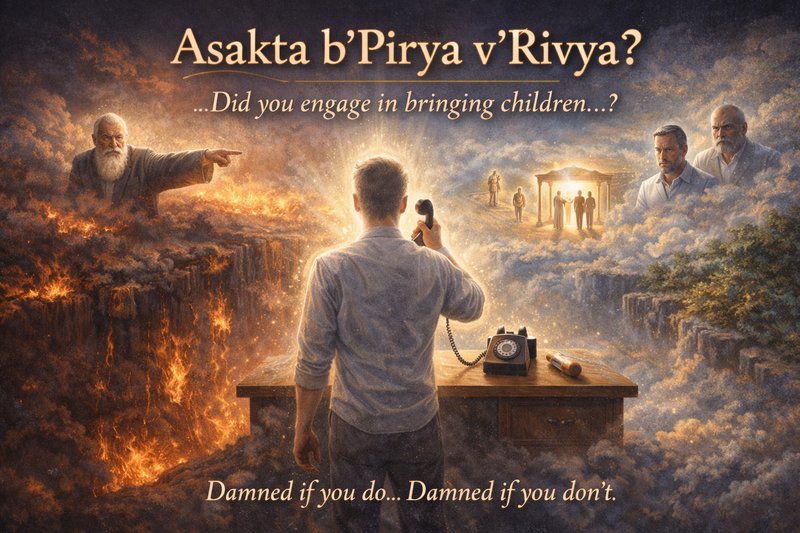
Rava’s question does not have an exemption clause. The neshamah standing in the world of emes cannot say “I stopped because R’ Chanina frightened me.” The Beis Din shel Maalah will not ask whether you were scared. It will ask: asakta b’pirya v’rivya? Did you do the work? And the shadchan who walked away will have to answer no. I stopped. I chose my own eternity over the chuppos I might have built. And while I was protecting myself, neshamos that were supposed to enter this world through my efforts did not enter. Shabbos tables that were supposed to exist do not exist. Children who were supposed to learn Torah were never born.
R’ Chanina says: do this work and cause someone pain, and you may descend to Gehinnom and never come back up. Rava says: refuse to do this work, and you will stand before the Beis Din shel Maalah unable to answer the third question. The phone is on the desk. Pick it up and risk the flask. Leave it there and face the question.
Damned if you do. Damned if you don’t. And in the world of emes, there has never been a third option.
The shadchan does not stand at the edge of the abyss by choice. Behind them is Rava. In front of them is R’ Chanina. The only direction is forward—into the work, into the risk, into the phone call that might lead to the flask or might lead to the chuppah. On the other side of that phone call there might be a chuppah. Under that chuppah the Shechinah descends. The deceased parents and grandparents descend from shamayim. Two neshamos that were one before they entered this world are reunited. The chosson and kallah cry—the right tears, the sacred tears—and the glass breaks and the room erupts and there is music and dancing and sasson v’simcha, chosson v’kallah.[16] Or there might be a tear. And that tear will pass through the gate that is never locked and reach the Kisei HaKavod and the shadchan will not know it happened because the shadchan is already on the next call.
Fire from shamayim for R’ Shmuel bar Yitzchak, who danced before the bride. Fire in Gehinnom for the person who stripped another of their dignity. Same element. The difference is the direction. A shadchan lives between those two fires every day and cannot tell which one awaits them until the chuppah happens or the tear falls.
———
B’makom sh’ein anashim, hishtadel l’hiyos ish.[17]
Tomorrow morning a shadchan will dial. Not because they are brave. Because Rava’s question is behind them and R’ Chanina is in front of them and somewhere on their list there is a person who has been waiting for the phone to ring with news that could change their life. And somebody has to make that call. And the person making it has to be someone who trembles. Someone who knows about the flask and the gates and the three who descend and never return and the six questions from which no neshamah is exempt. Someone who knows all of it and dials anyway.
Because on the other side of that phone call—past the abyss, past the flask, past the fire that burns in both directions—there might be a chuppah. And under that chuppah there might be tears that are the right tears. And from those tears there might come a Jewish home. And from that home there might come children. And from those children there might come generations. And all of it—every Shabbos candle, every brachah, every neshamah that enters the world because two people found each other—traces back to a single moment when a shadchan who was terrified of Gehinnom and terrified of Rava’s question and trapped between two eternities with no safe ground picked up the phone anyway.
Not courage. Compulsion. The compulsion of a neshamah that knows it will be asked asakta b’pirya v’rivya and cannot bear to answer no.

The Chesed L’Avraham describes a narrow path the neshamah walks after it departs this world.[18] On both sides, mazikim in the form of dogs bark and bite and try to pull the soul from the derech.[19] If the soul falls, it descends into the sixth madur of Gehinnom. The Zohar names that level: Tzalmavet.[20] The dogs and the domain share the same name—because you meet them on the path before you enter their territory.
Dovid HaMelech knew this map. Gam ki eilech b’gei tzalmavet lo ira ra, ki Atah imadi—shivtecha u’mishantecha hemah yenachamuni.[21] He was not describing a dark valley. He was walking through the sixth level of Gehinnom, dogs barking on both sides, and declaring: I will fear no evil. The Gemara identifies the rod and the staff: shivtecha—elu yissurin, u’mishantecha—zu haTorah.[22] Suffering for the rod. Torah for the staff. Not the absence of the dogs. The presence of the Shepherd.
And then Dovid cries out: Hatzilah mei’cherev nafshi, mi’yad kelev yechidasi.[23] Save my nefesh from the sword. Save my yechidah—the highest part of the neshamah—from the hand of the dog. He is davening for rescue from the tzalmavet.
This is the path the shadchan walks. Rava behind. R' Chanina in front. The dogs bark from both directions — the dog of causing pain and the dog of refusing to act — and the derech between them is so narrow that no one has ever walked it without trembling. Turn left and the flask fills. Turn right and the third question goes unanswered. Stand still and you are already falling. There is no direction a shadchan can face that does not lead to Gehinnom. The Gemara teaches: when the malach hamaves enters a city, the dogs bark.[24] A shadchan lives in that city.
And still: ki Atah imadi. Because You are with me. Not because the path is wide. Not because the dogs have gone quiet. Because the One who decreed the match forty days before the child was formed does not send a shadchan onto this path alone. The bas kol went forth. Someone has to carry it the rest of the way. And the One who spoke it walks with the one who carries it.
A shadchan picks up the phone every morning and steps onto that minefield.
——————————————————————————————
Sources
[1] Shabbos 31a, derived from Yeshayahu 33:6: “Ve’hayah emunas itecha chosen yeshuos chochmas va’da’as.”
[2] Sotah 2a; Bereishis Rabbah 68:4.
[3] Sotah 2a.
[4] Kesubos 17a.
[5] Kesubos 17a.
[6] Bava Metzia 58b.
[7] Avos 3:15.
[8] Bava Metzia 59a, from Tamar (Bereishis 38:25).
[9] Sefer HaChinuch, Mitzvah 338.
[10] Bava Metzia 59a.
[11] Shulchan Aruch, Choshen Mishpat 228:3.
[12] Bava Metzia 59a, citing Amos 7:7.
[13] Tehillim 56:9.
[14] Bava Metzia 59a; Berachos 32b.
[15] Bava Metzia 59b.
[16] Sheva Brachos, Kesubos 8a.
[17] Avos 2:5.
[18] Chesed L’Avraham, Ma’ayan 5, Nahar 8.
[19] Chesed L’Avraham, Ma’ayan 7, Nahar 23.
[20] Zohar, Pekudei II:242b; Masechet Gehinnom.
[21] Tehillim 23:4.
[22] Masechet Gehinnom on Tehillim 23:4.
[23] Tehillim 22:21.
[24] Bava Kama 60b.