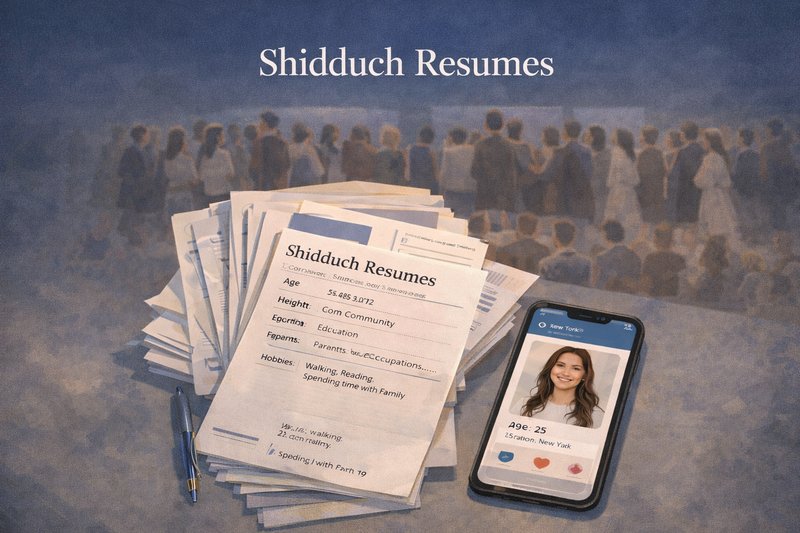
The shidduch resume was built to offend no one. That is precisely the problem.
Age. Height. Community. Education. Parents’ occupations. References. A hashkafa that fits neatly into a recognized category. Hobbies that could belong to anyone: “walking, reading, spending time with family.” The resume communicates, with extraordinary efficiency, that this person exists. It communicates almost nothing else.
Every trait that would make you you—the thing you are genuinely passionate about, the way your mind actually moves through a problem, the specific vision you carry for the bayit ne’eman b’Yisrael you want to build—gets sanded away in the editing. What survives is a profile that no one objects to, no one is excited by, and no one remembers the morning after they set it down.
The dating app performs the same surgery with better graphics. A handful of photos. A line of text. Age, location, a swipe. It compresses a human being into the smallest possible package—and the package is indistinguishable from every other package on the shelf.
And the large singles event—the ballroom event, the one organizations promote as the solution, the one everyone pins their hopes on—is no better. It is, in the end, a dating app with better lighting. Two hundred people. No structure. Conversations that last ninety seconds before someone’s eyes drift toward whoever just walked through the door. The few people who project the most obvious kind of attractiveness become the room’s center of gravity, and everyone else competes for whatever attention remains. You walk out feeling invisible—not because there is anything wrong with you, not because you are uninteresting—but because the format gave your actual strengths no possible way to surface.
This is the hidden logic underneath all three: the resume, the app, the crowded room. Each one takes a person with dozens of dimensions—humor, values, middos, the way they think about chesed, the specific thing that lights them up when they talk about it—and collapses all of it down to one. Height. Age. Background. Photo. And on that single dimension, the same small group wins every time. Everyone else waits. And wonders what is wrong with them.
Nothing is wrong with them. The format is wrong.
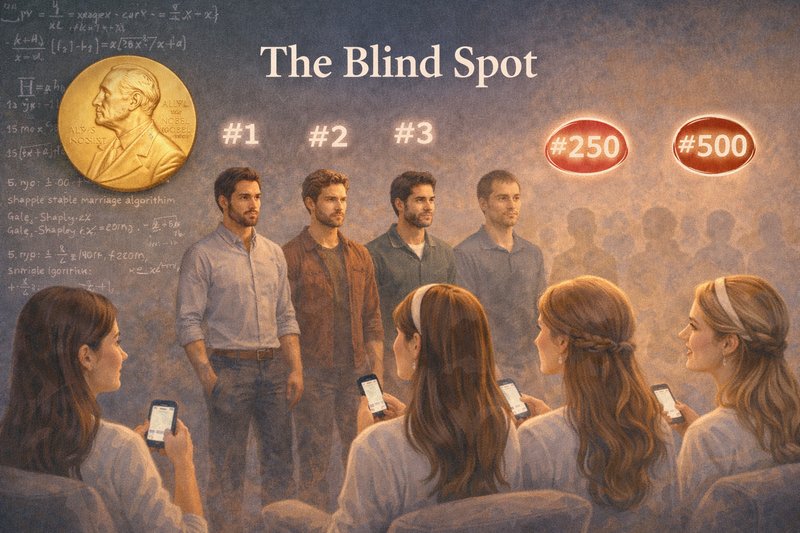
In 2012, the Nobel Prize in Economics went to the mathematicians who formalized what happens when people with correlated preferences try to pair off. The Gale-Shapley stable marriage algorithm is, at its core, a proof of how brutal a shared ranking system can be.[1] When everyone tends to agree on who is desirable—when the same names keep rising to the top of every list—the mathematics is merciless. In a population of five hundred, only five to ten percent end up with their first choice. The average person matches with someone ranked twentieth to fortieth on their list. The person ranked two hundred and fiftieth must make roughly two hundred and fifty proposals before someone says yes—not for lack of value, not because something is wrong with them, but because the structure of the market forces nearly everyone to compete for the same small group, and nearly everyone loses.
An ancient Midrash records a Roman noblewoman who challenged R’ Yose bar Chalafta, scoffing that she could arrange matches for a thousand servants in a single evening.[2] By morning, the room was chaos. She returned and conceded: matchmaking is as difficult as splitting the sea. The mathematics caught up eighteen hundred years later.
The dating platforms confirm what the algorithm predicts. On OkCupid, women rate eighty percent of men below the midpoint of attractiveness.[3] On Tinder, the top twenty percent of men absorb seventy-eight percent of all female likes—a Gini coefficient of 0.58, which makes the dating attention economy more unequal than ninety-five percent of the world’s national economies measured by income.[4] On Hinge, the male Gini reaches 0.73; the top one percent of men receive over sixteen percent of all likes.[5]
These numbers are not measuring shallowness. They are measuring what happens mathematically when selective people with similar preferences operate in an environment that gives them almost nothing to work with. When all you can see is a photograph and a line of text, you evaluate on the only dimension available. And on that dimension, consensus forms quickly—at the very top.
But here is what the models miss. They assume that the agreed-upon ranking extends from first place all the way down to five hundredth. At the top, it does—people broadly agree on who belongs in the top fifteen to twenty percent. Below that threshold, for the remaining eighty to eighty-five percent of the population, consensus dissolves entirely. One person’s fiftieth choice is another person’s third. One person’s “definitely not” is another person’s “exactly what I’ve been searching for.” The ranking does not become less accurate as you move down the distribution. It ceases to exist.
We call this the Blind Spot.
It is not that eighty-five percent of people are less desirable. It is that the instrument being used to evaluate them—an instrument built on the assumption that every human being can be ordered on a single shared scale—simply cannot see them. It resolves the top of the distribution with reasonable clarity. Then it goes blind.
And if you are in that eighty to eighty-five percent—and statistically, you almost certainly are—then the number the system assigns you is a fiction. You are a two to one person and an eight to another. The algorithm averages those scores and pronounces you mediocre. But mediocre is not what you are. You are someone’s first choice. The system simply has no mechanism for discovering whose.
The biology explains why person-specific attraction is not a romantic preference or a nice idea. It is how human beings are constructed.
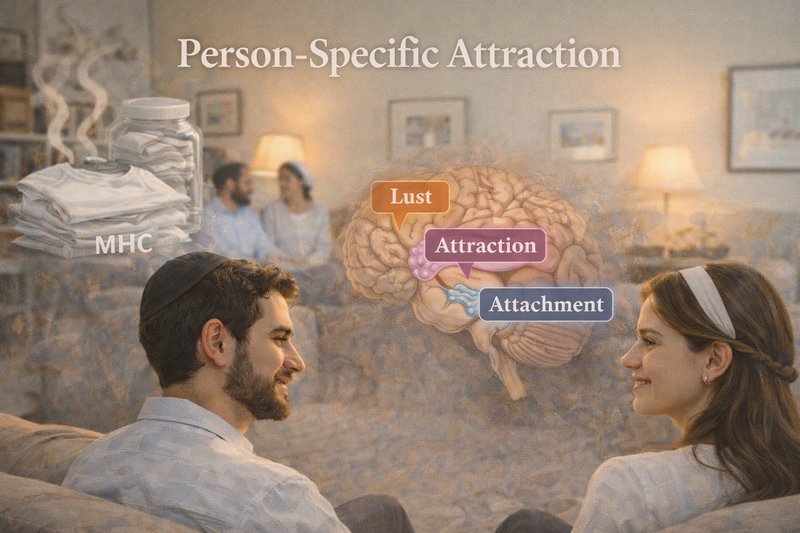
Claus Wedekind’s T-shirt study at the University of Bern found that women consistently preferred the scent of men whose immune systems differed most from their own—because the offspring of immunologically dissimilar parents develop broader, more robust defenses against disease.[6] The person who smells right to you is not the person who smells right to someone else. Not because of cologne. Because of immunogenetics. And this signal requires physical proximity. It does not transmit through a photograph. It does not transmit through a resume.
Bereczkei and colleagues demonstrated that human beings develop deep attraction templates from early formative experience—parental resemblance, childhood environments, the voices and gestures that became the felt texture of home.[7] These templates operate beneath conscious awareness. A person cannot explain why they are drawn to someone. They experience it as a pull—immediate, specific, and often entirely at odds with what they wrote on the intake form. A resume carries none of the cues that activate this recognition. Only sustained, real-time interaction does.
Helen Fisher’s research at Rutgers identifies three neurologically independent brain systems involved in pair bonding: lust, which responds to broadly shared physical signals; attraction, which is dopamine-driven and targeted at a specific individual; and attachment, which develops only through sustained interaction over time.[8] The implication is significant. You do not need to be universally attractive to trigger profound attraction in a specific person. You need to activate their particular triggers—shaped by their imprinting, their immune profile, their temperament, their history. A resume cannot do this. An app cannot do this. A ninety-second exchange across a ballroom cannot do this. A real conversation—the kind that unfolds over an evening, the kind that happens at a Shabbaton, the kind that happens when two people are given time and structure and a reason to actually be present with each other—can.
Four biological mechanisms. All of them person-specific. All of them requiring sustained interaction to operate. And all of them disabled by the resume, the app, and the crowded room—because the only signal those formats can carry is the universal one: how you look. The other three systems—the ones that actually determine whether two people belong together—are simply switched off. The top fifteen percent win on the one remaining dimension. Everyone else disappears. Not because they lack value. Because the format suppresses every channel through which their value would be visible.
Christian Rudder’s OkCupid analysis completes the picture.[9] He compared people with identical average attractiveness ratings but different variance—some rated consistently by everyone who saw them, others rated with wild disagreement, some giving them a one and others a five, averaging to the same score. The finding was striking. The consistent person—low variance, broadly acceptable, offensive to no one—received seventy percent fewer messages than the polarizing one. A person at the twentieth percentile of average attractiveness with high variance received as much attention as a person at the seventieth percentile with low variance. Fifty percentile points of difference. The gap between invisible and found.
The data is clear. The biology is clear. The Gemara is clear. So let’s talk about what actually changes.
The first thing is to stop being safe.
The resume trains you to sand yourself down—to present the version of yourself that will not raise any red flags, that will not make anyone say no before they say yes. The data says that strategy is the worst one available. The low-variance profile—the one engineered to offend nobody—is the one that receives seventy percent fewer responses. Inoffensive is invisible.
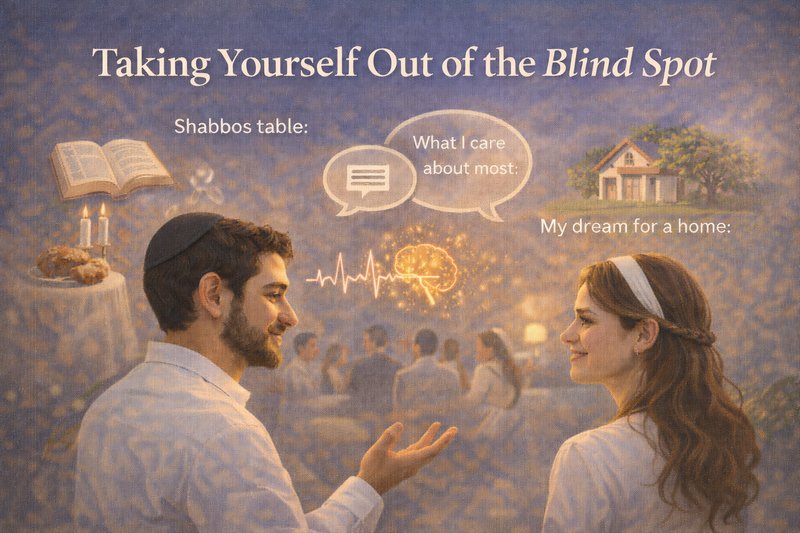
Be specific about who you are and what you are building. Not the version that fits neatly into a hashkafa checkbox. The real version. The thing you care about most. The way you actually want your Shabbos table to look and feel and sound. The kind of conversation that makes you lose track of time. The particular vision you carry for the bayit you are going to build. These are the traits that activate person-specific attraction—the dopamine triggers, the imprinting cues, the moment when someone across the table thinks this person sees the world the way I do. A resume cannot carry these things. A real conversation can—if you are willing to show up as yourself, and not as the version of yourself that was edited down to be easier to market.
The second thing is to put yourself in rooms where the format lets you be seen.
Not the ballroom with two hundred strangers and no structure. Not the app. Not the resume stack on a shadchan’s desk. The small room. The curated setting. The environment where there is enough time to actually talk—where structure creates the conditions for your real strengths to surface, where the conversation has somewhere to go.
Which brings us to your Yismach profile—because that is where the room begins.
Not the checkbox form. Not the sanded-down resume. The profile where you let the shadchanim actually know you. And there are two ways to get this wrong, and they are mirror images of each other.
The first is the one the old system trained you toward: play it safe. Make yourself acceptable to the widest possible pool. The data already told you what this produces—seventy percent fewer responses and a silence you mistake for a verdict about your worth. Generic is not humble. Generic is self-erasure. And it does not protect your options. It eliminates them.
The second failure is less discussed but equally damaging: the fantasy profile. The list of requirements so specific, so idealized, so perfectly assembled from every good date you have ever had, that no living person could walk through the door and satisfy it. That profile is not honesty. It is armor. And it keeps the right person out just as efficiently as the sanded-down one.
What you are building is neither of these. You are painting a picture—specific enough to be recognizable, honest enough to be real, open enough to let someone in. The details that light you up. The vision you actually carry. The texture of the life you are trying to build. Enough that a shadchan reading it thinks: I know exactly who this person is—and I know exactly who they need to meet.
That picture is what our AI sees. Yismach’s matching system takes the whole profile into account—your answers, your priorities, your photograph—and does something no resume stack and no swipe-based algorithm can do. It finds the specific person for whom you are the highest score.
Before a shadchan sends out a suggestion, they run the match comparison—a tool that shows what is under the hood. Not just that two people look right on paper, but why this particular pairing works. What it is about the specific combination of who you are and who they are that creates something neither of you could have predicted from a resume. Why this person, of everyone in the pool, is the one most likely to rev up your engine. And when that suggestion arrives, you can run it yourself. Log in. See exactly what the shadchan saw. Understand not just who is being suggested—but why.
The Roman noblewoman thought matchmaking was a logistics problem. A large enough room, a long enough list, enough names to sort through. By morning she understood. The sea does not split because you have good data. It splits because you are standing at the right shore, with the right guide, ready to walk through.
Go back to your profile. Read it like a stranger would. Ask yourself whether the person described there is someone you would recognize at a Shabbos table—or someone you could have assembled from a list of acceptable traits.
Then rewrite it. Be specific. Be honest. Trust that the right person is not looking for someone safe.
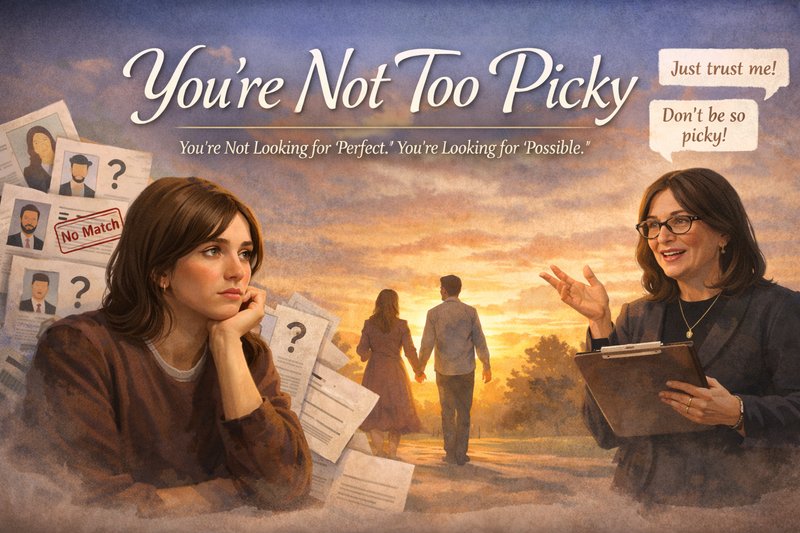
The Blind Spot doesn’t just hide you from the system. It corrupts the information you feed into it.
When a shadchan sits down with you and asks what you are looking for, you answer in the only language available: the resume language. Learner or working. Height range. Yeshivish or modern. Family background. You describe the person you think you want—assembled from the same categories the system already runs on—and the shadchan goes and finds them. They do their job. They bring you exactly what you asked for.
You meet. You sit across from each other. The resume matches. The hashkafa aligns. The height is right. And nothing happens.
The shadchan calls your mother. “I don’t understand. It was a perfect match on paper.” Your mother calls you. The conversation ends where it always ends: you are too picky.
But that is the wrong diagnosis entirely.
You are not too picky. You are misdescribed. You have been asked to specify your attraction in a language that cannot carry it—and when the system delivers exactly what you ordered and you feel nothing, the failure gets assigned to you. Your standards are too high. You don’t know what you want. You need to be more open.
What actually happened is simpler and more structural. The shadchan was working from a broken spec. Not because they don’t care—they care enormously—but because the information they were given was already filtered through a system that strips out everything that actually drives attraction. They are navigating by a map that cannot show the terrain. That is not their fault. It is the fault of the instrument.
The Blind Spot makes the shadchan the blind leading the blind.
The shadchan cannot see what the resume cannot say. And if you cannot say what you actually want—if you yourself don’t have the language for it, because the system never gave you that language—then the best shadchan in the world is working with one hand tied behind their back.
The fix is not to lower your standards. The fix is to describe yourself and what you are looking for in terms the system has never asked you for before. Not height and hashkafa. The texture of the Shabbos table you are building. The kind of mind you need across from you. The specific thing that makes a conversation feel like it could go on for hours. The vision, not the checklist.
When a shadchan has that—when the profile is specific enough to be real—they stop guessing. They stop bringing you the person who looks right on paper. They bring you the person who would recognize you.
That is a different kind of shadchan work. And it is what Yismach is built to support.
They are looking for you.
Sources
[1] Gale & Shapley, “College Admissions and the Stability of Marriage,” American Mathematical Monthly (1962). Nobel Prize in Economics awarded to Shapley & Roth (2012).
[2] Bereishis Rabbah 68:4.
[3] Rudder, C., “Your Looks and Your Inbox,” OkCupid Blog (2009); expanded in Dataclysm (2014), Crown Publishers.
[4] Tinder Gini coefficient analysis. See also Bruch & Newman, “Aspirational Pursuit of Mates in Online Dating Markets,” Science Advances (2018).
[5] Hinge internal analysis. Goldgeier, A. (2017), reported in Quartz.
[6] Wedekind, C. et al., “MHC-Dependent Mate Preferences in Humans,” Proceedings of the Royal Society B (1995), 260(1359):245–249.
[7] Bereczkei, T. et al., “Sexual Imprinting in Human Mate Choice,” Proceedings of the Royal Society B (2004), 271(1544):1129–1134.
[8] Fisher, H. E., Why We Love: The Nature and Chemistry of Romantic Love (2004), Henry Holt and Company.
[9] Rudder, C., “The Mathematics of Beauty,” OkCupid Blog (2010); expanded in Dataclysm (2014), Chapter 4.