It is told of R’ Naftali of Ropshitz that whenever he was invited to serve as mesader kiddushin, he would not go out to the chuppah until he saw the chosson shed tears.
One time, the badchan labored with all his skill to stir the chosson with words of mussar—but it was no use. The young man’s heart was hard as iron. He would not cry.
The Rebbe waited. And waited. Finally, he climbed onto a bench himself and spoke directly to the chosson:
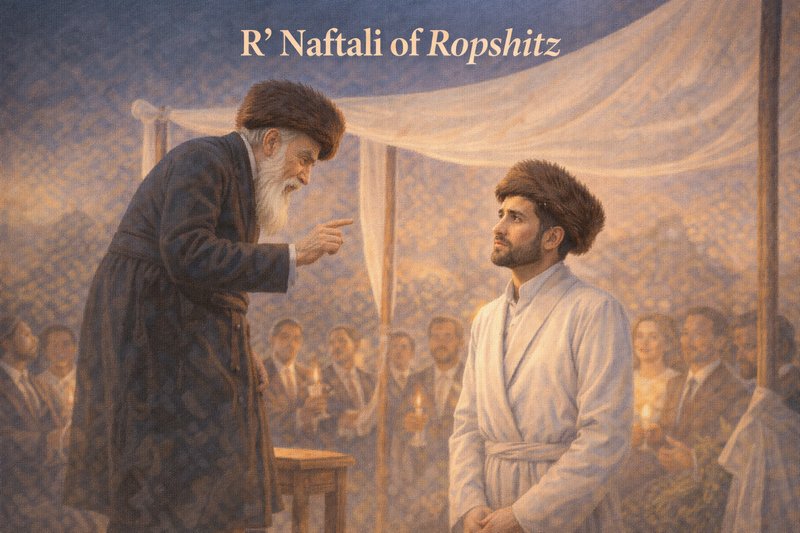
“My dear chosson, let me tell you something that once happened. A deer and a doe were together in the forest, delighting in each other’s company. Suddenly the deer leapt to his feet to flee. The doe cried out: ‘Where are you going?’ He pointed into the distance—a hunter was approaching with his rifle, a pack of dogs at his heels. ‘When will we meet again?’ she asked. And as he turned to run, his voice trembling, he answered: ‘I believe our next meeting will be—to our great sorrow—under the roof of the merchant who buys from the hunter. My hide together with yours.’”
The chosson understood. Like the thrust of a sword it pierced his hardened heart, and the tears came at last. The Rebbe called out: “Musicians! Take up your instruments! Lead the chosson to the chuppah!”[1]
———
There is a reason the chosson and kallah cry on their wedding day. The wedding day is compared to Yom Kippur[2]—they fast, their sins are forgiven, they stand in white before Hashem. The Shechinah itself graces every chuppah. The deceased parents, grandparents, and great-grandparents of the chosson and kallah descend from their heavenly abode to join the simcha. The tears that fall in that moment are tears of awe: an awareness of the magnitude of what is happening. Two souls that were one before they entered this world are being reunited.[3]
And then the glass breaks. And the room erupts. Mazel tov. Dancing. Music. Sasson v’simcha, chosson v’kallah, gilah, rinah, ditzah v’chedvah—joy and gladness, groom and bride, delight, jubilation, cheer, and exultation.[4] Seven blessings. Seven days of celebration. The tears are over. They were supposed to be brief, concentrated, sacred. A moment of breaking open before a lifetime of building together.
That is the design. Tears at the chuppah, then only simcha—not just for the evening, not just for the sheva brachos, but for a lifetime. The crying has a place, and that place has a boundary. It ends before the chuppah, and what follows is meant to be joy without measure, a marriage built on the foundation of that one sacred moment of tears.
———
But that is not what is happening anymore.
The tears no longer begin before the chuppah. They begin years before it. Sometimes they begin before the process itself does—before the first shadchan meeting, before the first profile is written, before anyone even picks up the phone on your behalf. They begin in the quiet. In the space between who you are and who you were told you need to be in order for this to work.
They begin the first time you look in the mirror and wonder whether you are enough. Whether your face is the right face. Whether your body is the right body. Whether the family you come from, the school you went to, the degree you earned or didn’t earn, the salary you make or don’t make, the neighborhood you live in—whether any of it adds up to whatever the invisible threshold is that separates people who get suggested from people who don’t. Nobody has to tell you that you are being measured. The system teaches you to measure yourself. And the measurements always come up short, because the system was never measuring what matters.
Then you enter the process. You sit in a shadchan’s office or on a phone call and you answer questions that feel less like a conversation and more like an appraisal. Height. Weight. Age. Hashkafah, reduced to a single word. Family background, reduced to a sentence. Years of becoming a person—years of growth, of struggle, of learning who you are and what you need—compressed into a paragraph that will be forwarded to someone who will glance at it for thirty seconds and decide whether you are worth a phone call. You walk out of that meeting and something has shifted. You came in as a person. You left as a file.
The suggestions start. Names put forward with no thought, no explanation, no evidence that anyone spent more than forty-five seconds considering whether two human beings might actually be right for each other. You say no to something that made no sense and you are told you are being too picky. You say yes to something you had doubts about because you were told to give it a chance, and then it goes nowhere, and nobody takes responsibility for the wasted time or the emotional cost of opening yourself to a stranger you already knew was wrong. Weeks pass with silence. You follow up and the silence continues. The message is clear even though nobody says it: you are not a priority. Your life—the one you are trying to build, the one that depends on this process working—is not urgent to the person who told you they would help.
And then the social weight begins. It does not arrive all at once. It accumulates. A friend gets engaged on a Thursday night and the simcha is real, the happiness is genuine, and you mean every word of the mazel tov—and underneath it there is a heaviness that you cannot name because naming it would make you a bad person. You sit at a Shabbos table and someone asks “so, anything new?” and the question is innocent but the silence that follows it is not. Your mother’s eyes at Yom Tov. The way conversations shift when you enter a room full of married couples. The slow, imperceptible reclassification from “single” to “still single” to something worse—something that lives in the pause before someone changes the subject.
Then come the dates. And here is where the cruelty becomes intimate, because it happens face to face. Not from anything said outright—nobody says “I find you unattractive” or “you bore me” to a person’s face. But a person knows. You can feel when the person sitting across from you decided five minutes in that this is going nowhere and has stopped trying. The eyes that drift. The questions that stop being curious and become polite. The body language that says “I am enduring this.” The checking of a phone. The way the conversation is steered toward ending early. You sit there and you feel it happening—the withdrawal, the disengagement—and you cannot say anything because nothing was said. You walk away from a date like that not with information about compatibility but with a feeling: the feeling of having been weighed and found wanting by a stranger who never said a single unkind word.
And sometimes it is worse than indifference. Sometimes it is the small, covert cruelties that the other person may not even recognize as cruel. The comment about your profession that carries just enough edge to suggest it isn’t impressive enough. The question about family that is really a question about status. The way someone talks about their own accomplishments in a manner designed to create distance—to establish, without ever stating it, that they are doing you a favor by being here. The subtle, wordless communication that you should be grateful for this date because the other person had better options. A person can walk out of an evening like that with their dignity intact on the outside and something broken on the inside that they will not be able to explain to the friend who calls the next morning to ask how it went.
Then come the rejections. Not the ones from strangers—those sting but they heal. The ones that destroy are the ones that come after you let yourself hope. After the third date, when something clicked, when the conversation flowed, when you walked away thinking maybe this is it, maybe this is the person Hashem had in mind—and then the call comes. It’s over. No explanation that makes sense. No reason you can argue with. Just the flat fact that what you felt was not felt back. And the hoping, which was the bravest thing you did that month, turns out to have been the most dangerous. You learn, after enough of these, to stop hoping early. You learn to hold back. And the system calls that holding back a problem—“she doesn’t open up,” “he’s emotionally unavailable”—as if the walls went up for no reason.
And then there are the ones that go further. Weeks. Months. You started to see it—the apartment, the Shabbos table, the life. You told your mother. You let yourself plan. You davened with a kind of specificity you hadn’t allowed yourself before—not “send me my zivug” but “let this be the one.” And then it ended. And the grief was not proportional to the length of the relationship but to the size of the future you had already begun to build inside your head. You mourn a life that never existed. You sit shiva for a marriage that never happened. And nobody brings you a meal because it is not a loss the community recognizes.
And then—for some—there is the worst of it. The broken engagement. After the l’chaim. After the mazel tovs. After you told the world. After the hall was booked and the dress was bought and the invitations were printed and your name was linked to another person’s name in the mouths of everyone you know. And then you had to untell the world. Phone call by phone call. Whisper by whisper. The ring returned. The dress that hangs in a closet like a ghost. The people who don’t know what to say and so say exactly the wrong thing—“Hashem has a plan,” “it’s better now than after the wedding,” “you’ll find someone better”—as if any of those words touch what is actually happening inside a person whose life just detonated in public. A broken engagement is not a setback. It is a reshaping. The person who emerges from it is not the same person who entered it. And the shidduch system, which should approach that person with extraordinary gentleness, too often approaches them with suspicion—as if being broken up with is evidence of a defect rather than evidence of having had the courage to try.
The shidduch process—as it currently operates—has taken the tears that were designed for the moments before the chuppah and spread them across years. Across the self-doubt that begins before anyone picks up the phone. Across the shadchan meetings that reduce a person to a paragraph. Across the dates where someone is made to feel small without a single word being spoken. Across the rejections that teach a person to stop hoping. Across the relationships that collapse without warning. Across the broken engagements that leave scars nobody sees. And the cruelest part of all: the system then blames the person crying.

The halachic weight of these tears is not abstract. Rav teaches in the Gemara: “A man must always be careful about the ona’ah of his wife, for her tear comes easily, and retribution for ona’ah comes swiftly.”[5] The Shulchan Aruch codifies this: one must be especially careful about causing emotional pain to a woman, because of her heightened sensitivity.[6] And the Be’er Heitev adds: Hashem sees her tears and exacts retribution from the one who caused them.[7]
The Pele Yoetz, in his entry on the love between husband and wife, elaborates on this obligation: a husband must exercise extreme care with his wife’s feelings, for women are sensitive by nature and their tears rise quickly.[8] Dovid HaMelech writes: “Simah dim’ati b’nodecha”—place my tears in Your flask.[9] Hashem collects every tear. Not one falls unseen. And the one who caused them will be held to account.
R’ Elazar teaches: since the destruction of the Beis HaMikdash, the gates of prayer have been locked. But the gates of tears were never locked.[10] Tears go straight to the Kisei HaKavod. No gate, no intermediary, no delay. When a person causes another to cry, that cry reaches Hashem directly. Ima Shalom, the wife of R’ Eliezer, expressed this principle in its starkest form: “All the gates of Heaven are locked except for the gates of ona’ah.”[11]
This principle applies to a husband. But the logic does not stop at marriage. The Gemara’s reasoning is not that husbands alone bear this responsibility—it is that anyone who causes pain to a person whose tears come easily, and whose emotional vulnerability is heightened by the circumstances they are in, will face swift judgment from Above. If a husband who causes his wife to cry must answer for every tear, how much more so anyone involved in the shidduch process—shadchanim, friends, family, the person on the other end of a date—who through carelessness, insensitivity, or indifference causes a single man or woman to cry?

The emotional toll of the shidduch process as it currently operates is not frustration. Frustration is what happens when a package arrives late. What happens to a person who spends years in this system—absorbing rejection after rejection, investing emotionally in relationships that dissolve without warning, rebuilding hope only to have it dismantled again—is something deeper and more corrosive. It is a slow erosion of trust—trust in the process, trust in the people running it, and eventually, trust in themselves.
Every person who has ever fallen for someone and been told it wasn’t reciprocated knows what this feels like. It is not the rejection itself that does the damage. It is the cumulative weight. One rejection is painful. Ten is deforming. After enough of them, a person stops interpreting each new “no” as information about compatibility and starts interpreting it as a verdict on their worth.
A person can only be made to feel that they are too picky so many times before they start to believe it. A person can only sit through careless suggestions—names put forward with no thought, no explanation, no evidence that anyone considered whether this could actually work—before they start to wonder whether anyone sees them at all. A person can only be made to feel like their worth decreases with every year they remain unmarried before something inside them begins to close. Not their standards. Their heart. Their willingness to be vulnerable with one more stranger who claims to know someone perfect.
And it is not only the dates that never call back. It is the shadchanim who make a person feel that their worth decreases with every year they remain unmarried. It is the suggestions put forward with no thought, no explanation, no evidence that anyone considered whether this could actually work. It is the weeks of silence following what was supposed to be an important intake conversation. Nobody has to say these words out loud. That is what makes it so insidious. A shadchan does not have to say “you are damaged goods” for a person to walk out of a meeting feeling like damaged goods. A shadchan does not have to say “you are not worth my time” for a person to feel exactly that. The feeling is the injury. And the halacha is clear: ona’as devarim—emotional harm—is judged by the experience of the one who suffers it, not the intention of the one who inflicts it.[12]
And then the system calls that closing a problem. “She’s too rigid.” “He won’t give anyone a chance.” As if the walls went up for no reason. As if years of being dismissed, rejected, dropped, and ghosted would not make anyone protective of what little hope they have left.
———
The Mishnah in Avos states this with terrifying clarity: R’ Elazar of Modi’in teaches that one who shames another person in public—hamalbin pnei chaveiro b’rabim—even if that person possesses Torah and good deeds, has no share in the World to Come.[13]
Mar Zutra bar Tuvya teaches: it is preferable for a person to throw himself into a fiery furnace rather than embarrass another person publicly.[14]
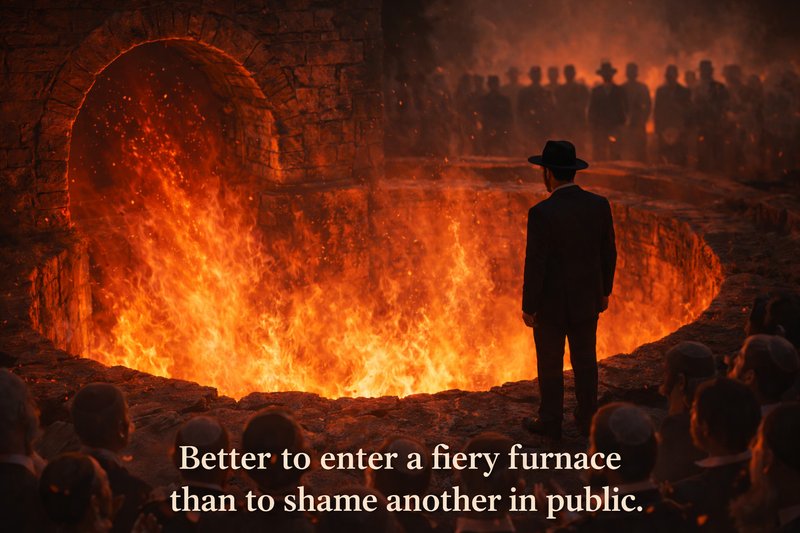
And R’ Chanina teaches: all who descend to Gehinnom eventually ascend—except for three: one who commits adultery with a married woman, one who shames his fellow in public, and one who calls his fellow by a derogatory name.[15] Three categories. Two of them—shaming someone publicly and calling them by a degrading name—are about the way we make other people feel. And the punishment is not temporary. It is permanent. They descend and do not come back up.
Think about the weight of that. Gehinnom, according to the Gemara, has an end point. People are cleansed and they ascend. But for the person who humiliates another—who strips someone of their dignity in a way they cannot recover from—the descent has no return. The accounting is not of this world, and it does not expire.
A shadchan who is not sensitized to the feelings of the people in their care—who treats intake meetings as transactions, who offers suggestions without thought, who allows weeks of silence to communicate that a person is not worth a response—may not intend to cause shame. But shame is what is caused. And the Beis Din shel Maalah does not judge by intention alone. It judges by the tears that were shed. Every tear is placed in a flask before the Kisei HaKavod. Every shadchan who has taken upon themselves the sacred work of shidduchim must understand: if the halacha demands that a husband bend over backwards to avoid bringing his wife to tears, how much more must anyone involved in this process bend over backwards to avoid bringing someone already in a vulnerable, painful place to tears? The gates of tears are never locked. The accounting is precise. And the consequences are not of this world.
Everyone who participates in the shidduch process—shadchanim, parents, friends, the person sitting across the table on a date—must understand what is at stake. A careless word about someone’s age. A dismissive comment about their appearance shared in a conversation that was supposed to be confidential. A rejection delivered with cruelty when it could have been delivered with kindness. A broken engagement handled in a way that broadcasts someone’s pain to the entire community. And the person on the date who made the other person feel small without saying a single unkind word—who communicated through body language, through disinterest, through the unmistakable signal that this was a chore—that too is ona’ah. The halacha does not require words. It requires pain. Each of these sends tears into the flask. And Hashem punishes for ona’ah directly—not through a shaliach, but b’Yado—with His own hand.[16]
———
What was lost is not efficiency. Efficiency is a business problem. What was lost is kedushah. The shidduch is a sacred process. The match is made in shamayim.[17] The work of the shadchan is not to create something that doesn’t exist. It is to reveal something that already does. That work requires sensitivity. It requires patience. It requires treating every person who walks through the door not as a file to be processed but as a neshamah searching for the other half of itself.
And the obligation does not rest on shadchanim alone. Every person who dates carries the dignity of another human being in their hands. Every phone call that ends a relationship is a moment where a person’s hope is being handled. You can handle it with care or you can handle it with carelessness, and the halacha treats the difference between those two things as the difference between olam hazeh and olam haba.
The Gemara in Kesubos establishes as a matter of halacha that we are obligated to bring joy to a chosson and kallah—that even Torah study is set aside to dance before a bride.[18] The entire framework assumes that the people surrounding the process are there to uplift. To protect. To honor. Somewhere along the way, for too many singles, the experience became the opposite. The people who were supposed to carry them to the chuppah with simcha became the reason they dread the journey.

And yet.
Dovid HaMelech did not write “those who sow in tears shall forget the tears.” He wrote that they shall reap b’rinah—with songs of joy.[19] The tears are not erased. They are transformed. The sowing is real. The pain is real. But the harvest is also real, and it comes with a joy so full it bursts into song.
The suffering is not meaningless. It is not random. It is not punishment for being too picky or too old or too anything. It is the sowing.
Every person who has opened their heart to someone and had it handed back—that is a seed being planted in tears. Every person who let themselves hope after a first date, a third date, a fifth date, only to have the phone ring with news that the other side wasn’t interested—that is a seed being planted in tears. Every person who invested months in a relationship that ended without warning, who stood in the wreckage of a broken engagement and somehow got dressed the next morning—that is the hardest sowing there is. Every person who maintained their dignity when the process tried to strip it—who said “no” to the suggestion that made no sense even when saying no meant being called difficult—that is emunah disguised as stubbornness.
The tears you have shed during this process are not a sign that something is wrong with you. They are a sign that you are serious about something sacred. You refused to treat the search for your zivug as a transaction. You refused to settle for a system that treated you like inventory. You held onto the belief that this process is supposed to have kedushah even when every experience told you otherwise. That refusal—that stubborn, painful, lonely insistence that you deserve better—is not pickiness. It is emunah.
———
The tears were supposed to begin on the wedding day and end at the chuppah. For too many people, they begin years before it—caused not only by the carelessness of shadchanim but by the accumulated weight of every rejection, every relationship that dissolved, every engagement that shattered, every night spent wondering what is wrong with you when nothing is wrong with you. That is what needs to change. Not you. Not your standards. Not your willingness to keep going. The way this process treats people.
B’rinah yik’tzoru. They shall reap with songs of joy.
That harvest is coming. And when it does—when you stand under the chuppah and the tears finally fall for the right reason, tears of awe, tears of a soul recognizing the magnitude of what Hashem has done—those tears will carry the weight of everything that came before. Every careless suggestion. Every person who didn’t call back. Every relationship that started with hope and ended with silence. Every broken engagement. Every night alone wondering if the problem was you. All of it, transformed. All of it, redeemed. All of it, sown in tears and reaped in a joy so complete that the only possible response is song—not just under the chuppah, not just for seven days, but for a lifetime.

Rachel Imeinu wept for her children and refused to be consoled. And what was the consolation Hashem finally offered her? Not that the tears would stop. Not that the pain would be explained. Two perakim later, the navi gives the answer: “Od yishama b’arei Yehudah… kol sasson v’kol simcha, kol chosson v’kol kallah.” There will yet be heard the sound of joy and gladness, the voice of the groom and the voice of the bride. The only thing that answers the tears is the promise that the chuppos will come. And the tears themselves are that promise.[20]
——————————————————————————————
Sources
[1] Told in the name of R’ Naftali of Ropshitz. Compiled in Hidabroot (Question 20409); widely cited in chassidishe sources on the minhag of the chosson’s tears before the chuppah.
[2] Yerushalmi Bikurim 3:3; see also Maharil, Hilchos Nisuin. The chosson and kallah fast, their aveiros are forgiven, and many communities have the custom that they say vidui during Minchah.
[3] Sotah 2a: “Forty days before the formation of the child, a bas kol goes forth and declares: bas ploni l’ploni—the daughter of this one is destined for that one.”
[4] From the seventh of the Sheva Brachos, Kesubos 8a.
[5] Bava Metzia 59a. The Gemara uses the language “l’olam y’hei adam zahir b’ona’as ishto, sh’mitoch sh’dim’atah metzuyah, ona’asah k’rovah.”
[6] Shulchan Aruch, Choshen Mishpat 228:3.
[7] Be’er Heitev, Choshen Mishpat 228:4.
[8] Pele Yoetz, Ahavat Ish v’Isha (entry 4), by Rav Eliezer Papo (1785–1828).
[9] Tehillim 56:9.
[10] Bava Metzia 59a; also found in Berachos 32b. The verse cited is Tehillim 39:13: “al dim’ati al techerash”—be not silent at my tears.
[11] Bava Metzia 59b. Ima Shalom said she had a tradition from the house of her father, Rabban Gamliel, that “kol ha’she’arim ninalu chutz mi’shaarei ona’ah.”
[12] Sefer HaChinuch, Mitzvah 338: the prohibition of ona’as devarim is defined by the pain caused, and unlike monetary harm, it cannot be repaid or corrected.
[13] Avos 3:15 (some editions 3:11). The full text lists five categories: one who desecrates sacred objects, one who disgraces the festivals, one who shames his fellow in public, one who annuls the bris of Avraham Avinu, and one who interprets the Torah contrary to halacha.
[14] Bava Metzia 59a. The proof is from Tamar, who chose to be burned rather than publicly embarrass Yehudah (Bereishis 38:25).
[15] Bava Metzia 58b. The Gemara clarifies that calling someone by a derogatory name is listed separately because even a name the person is accustomed to being called, if used with intent to demean, is included in the prohibition.
[16] Bava Metzia 59a. R’ Elazar teaches that for ona’ah, Hashem exacts retribution directly. The verse cited is Amos 7:7.
[17] Sotah 2a.
[18] Kesubos 17a: “Ma’avirin es ha’meis v’es ha’kallah—meisi’in es ha’kallah kodem.” One interrupts Torah study to escort a bride. See also Rambam, Hilchos Avel 14:1.
[19] Tehillim 126:5. The Metzudas Dovid explains that the joy of the harvest is proportional to the hardship of the sowing.
[20] Yirmiyahu 31:14–16; 33:10–11. Rachel weeps for her children and refuses to be consoled. Two perakim later, the navi delivers the consolation: “Od yishama b’arei Yehudah… kol sasson v’kol simcha, kol chosson v’kol kallah.” See also Eicha Rabbah, Pesichta 24.