On the science of connection — and why the system gets it wrong
The “where is this going?” conversation rarely ends well. Everyone knows this. Shadchanim know this. The people who ask it know this, even as they ask it. The relationship was alive — uncertain, moving, full of potential futures — and then someone needed to know what it was, and the asking changed everything.
This isn’t sentimentality. It’s physics.
The study of intimate relationships has spent decades building a predictive science of love — compatibility scores, trait inventories, personality typologies. The implicit promise was simple: measure enough variables with enough precision, and you can know whether two people belong together before they do. What the science has actually discovered, when you look at where the field has moved over the last twenty years, is the opposite. The more rigorously researchers have tried to capture what happens between two people, the more clearly the data has pointed toward something that resists capture.
Real connection is a dynamical system. And dynamical systems don’t behave like checklists.
Classical models — the ones that partition compatibility into measurable vertices of personality and interest and values — work reasonably well for describing what a relationship looks like from the outside, after the fact. They are poor predictors of what will happen before it does. They treat the anomalies — the couple who shouldn’t have worked but did, the pair with perfect profiles who felt nothing — as statistical noise, error, outliers to be averaged away.
They are not noise. They are the signal.
What researchers working at the intersection of physics and psychology have begun to recognize is that relationships are characterized by what scientists call sensitive dependence — the butterfly effect applied to intimate interaction. A single misaligned tone in a first conversation can diverge trajectory exponentially. Two people who might have found each other under slightly different conditions never do because of how the meeting was framed, when it happened, what had just occurred in each person’s morning. The outcome depends on initial conditions in ways that are, by their mathematical nature, unpredictable.
This is not a problem with the data. This is a feature of the system.
The systems that connect two people can be mapped using attractors — stable patterns that a system gravitates toward over time. Some relationships settle into fixed equilibrium: predictable, calm, unchanging. Others cycle through the same oscillating pattern, the same pursuit-and-withdrawal rhythm, reliably recurring. And then there are what mathematicians call strange attractors. These are the systems that never settle, never repeat the exact same interaction twice, yet remain recognizably themselves. They have structure at every scale. They are bounded without being repetitive. No two points on the trajectory are identical, but the overall shape — the feel of the relationship, its particular texture — remains constant.
The healthiest relationships are strange attractors. They resist boredom without collapsing into chaos. They are surprising without being unstable. There is no algorithm that generates them, because their complexity is infinite, and no two of them look the same.[1]
The shidduch system, as currently built, is optimized to produce fixed-point attractors. We have constructed an elaborate infrastructure for finding the couple who will settle into predictable equilibrium — same hashkafa, same background, same family type, overlapping résumés. Stability is not a small thing. But stability at a low-satisfaction threshold is not a marriage; it is a prolonged roommate arrangement. And strange attractors cannot be generated by matching vertices.
The quantum formalism for understanding emotional states is newer and, to some, counterintuitive. But its central insight is straightforward: before commitment, a relationship exists in multiple potential futures simultaneously. Not as a philosophical abstraction. As a real property of the system.
The physicist’s language for this is superposition. A particle held in superposition does not have a definite state — it exists as a distribution of possible states, each weighted by a probability amplitude, that collapses into one when measured.[2] What quantum cognition researchers have found is that human emotional states behave similarly. A person’s feeling toward someone they’ve been dating three times is genuinely not a single definable thing. It is a distribution of possibilities — excitement and uncertainty and something like fear, layered over one another — that resolves into something more concrete only when it is observed, pressed, articulated.
The “where is this going?” conversation is a measurement event. It forces collapse.[3]
Sometimes the collapse reveals what was already there. But often, the relationship had not yet evolved to the point where forcing it into a definite state produces anything useful. The superposition was, in fact, the right description of the moment. What someone feels after six dates is a superposition of “this could become something” and “I’m not sure yet” and “there’s something I like but I can’t place it.” Asking them to collapse that into a yes or no does not reveal the underlying truth. It terminates a process that wasn’t finished.
Shadchanim know this intuitively. The formal language just confirms what experienced matchmakers have seen for decades: push too hard for a definition too early, and you kill what might have grown.
There is a related phenomenon that physicists call the quantum Zeno effect. If you measure a quantum system frequently enough — if you observe it constantly, checking at every moment whether it has changed — you paradoxically prevent the change from occurring. The system freezes in its current state because it is never given the time to evolve without interruption.
In shidduchim, the equivalent is what happens when a single is checking after every date: asking the shadchan whether he seems interested, whether she looks like she wants to continue, whether there has been any feedback yet. What happens when parents are texting mid-evening to ask how it’s going. What happens when a couple is so focused on evaluating whether they should continue that they cannot simply be inside the interaction without it being observed.
The measurement prevents the evolution. The checking freezes the system. The desire to know too early is, by its nature, self-defeating.
This is one of the reasons the most damaging thing about résumé culture isn’t the résumé itself — it’s that it trains people to be in measurement mode before they’ve done anything worth measuring. By the time two people sit down across from each other, they’ve already measured enough to have a verdict. The first date is not an exploration; it is a confirmation exercise. And confirmation exercises collapse superpositions before they have time to develop into anything real.
The third insight from quantum relational science is perhaps the most counterintuitive. It involves what happens to two people who have formed a deep bond — not just emotionally, but at the level of their physiological state-space.
The term is entanglement. Two particles that have interacted in the right way become entangled — their states are no longer separable. You cannot describe the state of one without reference to the other. The relational version is about what it means when two people have truly bonded.
Emotional entanglement is not metaphor. It is measurable. Couples who have spent years together show inter-brain coupling — neural synchrony that has no explanation except that they have been in relationship with each other. Their physiological states regulate each other. Their nervous systems have become, in a real sense, co-attuned. The quality of one person’s voice changes the other’s heart rate variability. Their immune systems fluctuate in parallel.[4]
There is a principle in quantum mechanics called the monogamy of entanglement: if a particle is maximally entangled with one other particle, it cannot be equally entangled with a third. The resource is singular. A person who has formed a genuine emotional bond of this depth with one person cannot simultaneously form the identical bond with another. This is not a religious claim. It is a structural one. The Torah world has always understood this about marriage; what’s interesting is that the physics confirms it at an architectural level.
What breaks relationships, the quantum framework suggests, is almost never what the couple thinks is breaking them. They fight. They diverge. They feel far from each other. They diagnose incompatibility. But what physiological research shows — when you actually monitor the inter-body coupling between couples over time — is that most relational distance is decoherence, not incompatibility.
Decoherence is what happens when environmental noise scatters the phase relationship between coupled particles. The quantum system was entangled; it still is, technically; but the coherence — the ability of that entanglement to manifest as synchronized behavior — has been disrupted by interference from outside. The particles haven’t changed their fundamental nature. They have been bombarded by noise until they can no longer express it.
Work stress. Parents. Financial pressure. Children. The slow accumulation of unprocessed disagreement that becomes its own form of static. These don’t destroy the underlying bond. They decohere it. And decoherent relationships look, from the inside, exactly like incompatible ones. The feeling is the same. The distance is the same.
The treatment is not the same.
A broken relationship requires grief, ending, rebuilding from the ground up. A decoherent one requires shielding — reducing the environmental interference, creating conditions in which the underlying bond can reassert itself. It requires, in practical terms, removing the couple from the noise and giving them uninterrupted time to re-synchronize. The people who go on a trip alone together after years of accumulated busyness and return transformed — they have not had a romantic epiphany. They have achieved coherence revival. They needed less noise, not more work.[5]
Forty days before the formation of a child, a bas kol announces his zivug. This is what the Gemara in Sotah tells us. The match is declared before the people involved know anything about each other, before they have any profiles to review, before they have done anything to earn or prove themselves worthy of the connection that will be theirs.
This is the deepest statement in the tradition about what a zivug actually is. It is not constructed from data. It is not assembled from compatible attributes. It exists, in potential, before any measurement has been taken — exactly as a quantum state exists before the observer arrives.
The task of the shadchan, and of the couple, and of the system being built to support them, is not to predict this outcome. Prediction is the wrong model. The task is to create conditions under which a superposition can evolve without being collapsed prematurely — to reduce the noise that causes decoherence, to keep measurement from freezing what should be allowed to move, to trust that what the tradition has always known about zivugim is confirmed by the most rigorous science we now have: that connection is non-linear, unpredictable at the point of formation, and characterized by the kind of strange attractor that no compatibility algorithm can generate.
The résumé was supposed to help. Instead, it became the measurement event that collapses the superposition before the quantum system has had time to develop. The checklist was supposed to clarify. Instead, it forces a fixed-point attractor in a system that needed room to find its strange one.
The science doesn’t tell us to abandon standards or ignore character or pretend that compatibility doesn’t matter. It tells us something more specific and more useful: that the kind of compatibility which actually predicts a lasting, richly alive marriage cannot be measured before the relationship exists. It can only be observed inside the relationship as it unfolds. The attractor cannot be identified in advance. It can only be recognized by its shape.
The most sophisticated matchmaking is not the most analytical. It is the most tolerant of uncertainty, the most resistant to premature closure, the most skilled at holding open a superposition while the underlying entanglement has time to form.
A shadchan who says “I don’t know why, but I think they should meet” — and is right — is not guessing. She is detecting signal that resists formalization. She is working with the system the way the system actually operates, rather than the way we have modeled it for the sake of scalability.
The work of Yismach is not to replace that instinct with an algorithm. It is to build infrastructure around it — to remove the noise, reduce the friction, give the superposition the time and space it requires, and trust that what the bas kol announced forty days before formation will find its way to the surface, given the right conditions.
Strange attractors do not need to be built. They need to be allowed.
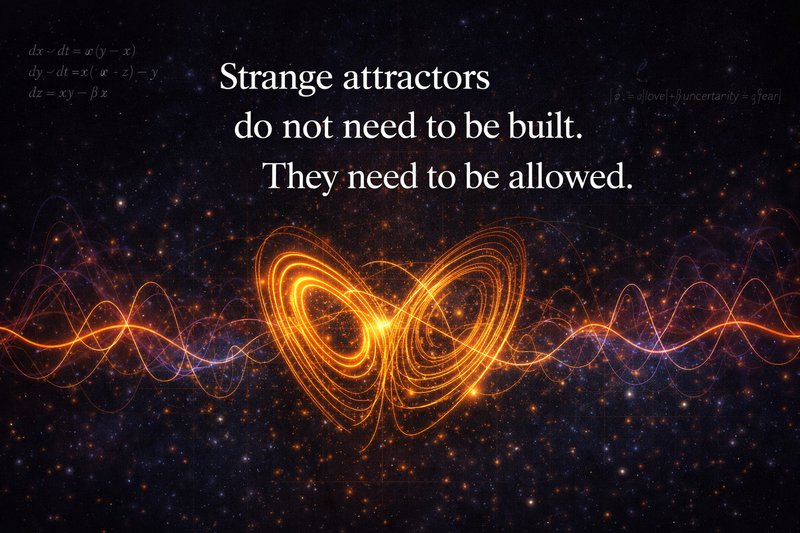
[1]The relational state-space of a dyad can be modeled using a Lorenz-type attractor system: dx/dt = σ(y − x), dy/dt = x(ρ − z) − y, dz/dt = xy − βz, where x = closeness, y = trust, z = conflict. A positive Lyapunov exponent — measuring sensitivity to initial conditions — establishes that long-term unpredictability is structural, not a measurement artifact. See Edward Lorenz, “Deterministic Nonperiodic Flow,” Journal of Atmospheric Sciences 20 (1963): 130–141.
[2]An emotional state is formally represented as a state vector: |ψ⟩ = α|love⟩ + β|uncertainty⟩ + γ|fear⟩, subject to the normalization constraint |α|² + |β|² + |γ|² = 1. The amplitudes represent probability weights over possible states. See Jerome Busemeyer and Peter Bruza, Quantum Models of Cognition and Decision (Cambridge University Press, 2012).
[3]Relational assessments involve non-commuting measurements: [A, B] ≠ 0. Asking about commitment (A) before satisfaction (B) produces a different state than the reverse sequence. This is not a survey design flaw; it is a structural property of the system. See Busemeyer and Bruza (2012), ch. 4.
[4]The internal dynamics of a bond can be represented by the Relationship Hamiltonian: H = H₀ + Hᵢₙₜ + Hᵉˣₜ(t), where H₀ captures individual emotional dynamics, Hᵢₙₜ is the coupling term (the chemistry between two people), and Hᵉˣₜ(t) accounts for time-varying external stressors. The coupling term is precisely what résumé-based screening cannot detect.
[5]Coherence revival can be modeled in terms of total relational energy: Eᵣᵉₗ = Eₗ₀ᵥᵉ + Eᶜ₀ₘₘᵢₜₘᵉₙₜ + Eᵣᵉₛ₀ᵘᵘᵉₛ + Eₛᵘₗₗ₀ᵣₜ. When environmental noise reduces E below the coherence threshold, the system decoheres without the underlying bond being severed. Barrier narrowing (targeted repair of a specific rupture) and energy enhancement (restored oxytocin/dopamine regulation) are the two practical paths to coherence revival. See John Gottman, The Science of Trust (W. W. Norton, 2011).