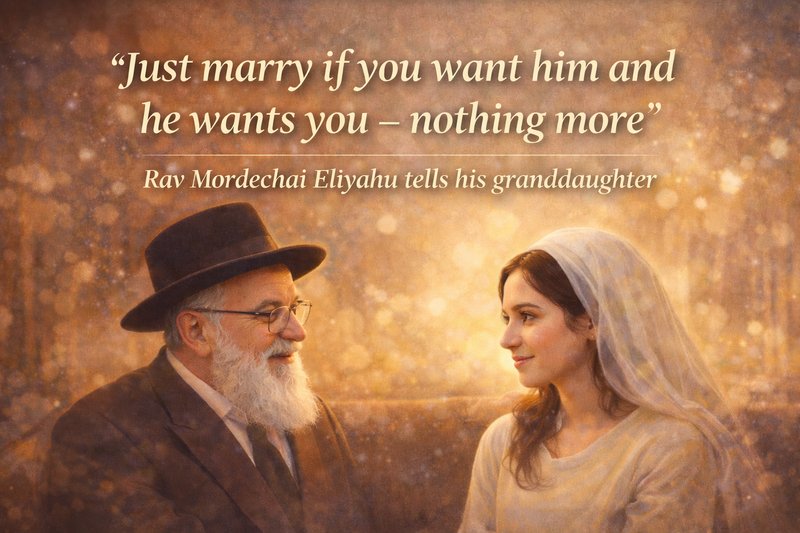
He Wants Her and She Wants Him
Rav Mordechai Eliyahu’s conclusion about soulmates follows directly from what the Arizal already wrote. Nobody followed the logic to the end.
The teaching came through a granddaughter. Rav Mordechai Eliyahu — Rishon LeTzion, posek hador — told her something about shidduchim that the Orthodox world has not absorbed.
Today, he said, there are no soulmates.
Not in the sense the shidduch world assumes. Not the original pairing — two halves of one soul created together before the first descent, waiting to find each other in this world. That pairing, Rav Eliyahu taught, no longer exists for the souls alive today.
This is not a mystical assertion beyond the reach of argument. It follows, step by step, from premises the Arizal himself set down in the Sha’ar HaGilgulim. Follow the logic and you arrive exactly where Rav Eliyahu arrived.
STEP ONE: MARRIAGE CREATES A SOUL-BOND THAT OUTLASTS DEATH
The Arizal teaches in Hakdama 8 of the Sha’ar HaGilgulim that when a man sins and must reincarnate, his wife reincarnates with him — even though she has no independent need to return, and even though she is not his original bat zug. She is bound to him by the marriage. The chuppah they stood under in that lifetime created a soul-bond between them, and that bond does not dissolve at death. It carries forward. When he returns, she returns with him.[1]
This is the hinge on which everything turns. The Arizal is not describing an edge case or a curiosity. He is stating a principle: marriage binds souls across lifetimes. The bond formed under the chuppah is not erased when the body dies. It persists into the next incarnation.
The bond formed under the chuppah persists into the next incarnation. The Arizal states this plainly.
STEP TWO: THAT BOND ACCUMULATES
Now apply the principle across time.
A soul enters the world for the first time. It marries. That marriage was not necessarily with the original bat zug — the Arizal explains at length all the reasons why the original pairing may not be available: she completed her rectification and did not return, another soul preempted the match through tefillah, the soul’s root is one whose female counterparts cannot emerge until Mashiach. For most souls, the first marriage is already with someone other than the original other half. But the marriage happens, the chuppah is real, and the bond is formed.[2]
The soul sins. It must reincarnate. It returns — and its wife from the previous life returns with it, bound by the marriage. Now this soul is entangled with her. In this second life it may marry again — perhaps her again, perhaps, through the complexities of gilgul, someone new. Another chuppah. Another bond.[3]
The soul sins again. Returns again. Now it carries the imprint of two marriages from previous lives. It enters a third lifetime already entangled. A third marriage may form. A third bond is added.
The Arizal does not place a limit on this process. He describes it as the mechanism by which souls are rectified across multiple lifetimes. Each incarnation is shaped by what came before. Each marriage adds to what the soul carries forward.[4]
Each marriage adds to what the soul carries forward. The Arizal places no limit on this process.
STEP THREE: THE ORIGINAL PAIRING IS BURIED
The soul that enters this world today is not a clean slate. It is the product of this accumulated process — shaped by marriages that happened in lifetimes it has no memory of, carrying bonds it cannot see or name, entangled with souls it has no conscious knowledge of. The original bat zug — the soul created as one with it before the first descent — has been through the same process from the other side. She, too, has been married before. She, too, carries entanglements. She, too, has been transformed by what happened in between.
The two halves that were created as one are no longer what they were when they were created. They have each been shaped, altered, and entangled by centuries of real marriages in real lifetimes. The original pairing still exists in the sense that those two souls still exist. But the clean unity that characterized them before the first descent — before any of this happened — has been overlaid by everything that came after. The souls that stand at the chuppah in this generation are not standing there as their original selves. They are standing there as the accumulated product of everything their previous selves went through.
This is Rav Eliyahu’s conclusion stated precisely: the original soulmate — the one created with you as one being — no longer exists in a recoverable form. Not because the soul ceased to exist. Because through actual marriages in actual previous lifetimes, both souls have become something different from what they were.
The original soulmate no longer exists in a recoverable form. Both souls have become something different from what they were.
STEP FOUR: THE SHIDDUCH WORLD IS SEARCHING FOR SOMETHING THAT ISN’T THERE
The shidduch world runs on a single premise: that there is a right person, the bashert, the cosmic match, and that sufficient effort will locate him or her. The background checks, the reference calls, the age calculations, the family investigations, the conviction that someone better is always coming — all of it is organized around finding that one destined match.
The Arizal’s own framework, followed to its conclusion, shows that this match — in the sense of the original soul created with yours — is no longer findable. The question is not who you were made for at the beginning of creation. That question has been answered already, many times over, by marriages that happened in lifetimes you cannot remember. The question that remains is the only one still answerable.
He wants her. She wants him.
Rav Eliyahu is not replacing one checklist with another. He is dissolving the premise that makes the search feel necessary. If there is no predetermined correct answer encoded in the upper worlds — no original soulmate to locate — then the machinery built to find that answer is machinery built for nothing. The resume does not contain what you are looking for. The reference call does not produce it. The age mathematics encodes nothing about the original pairing because the original pairing is no longer the question.
The question is simpler and more honest. Does this person, having met this person, want this person? That question has no answer in a resume. It has no answer in a reference call. It has no answer in the family background or the age or the schools. It has exactly one place where its answer lives: in the room, with the actual person, after enough time for the actual person to have emerged.
But the original pairing is not lost forever. The Arizal teaches that at Techiyat HaMetim — the resurrection of the dead, when all gilgulim have run their course and the final rectification is complete — every soul will be joined to the one it was created with. The man who married three women across three lifetimes, none of them his original bat zug, will stand at the resurrection united at last with the soul that was formed as one with his before the first descent. And each of those three women — who accompanied him through his gilgulim not because they were his original match but because the marriage bond carried them forward — will each be returned to her own original other half. Every entanglement resolved. Every original pairing restored. The entire accumulated weight of history’s marriages unwound into the unions that were meant to be from the beginning.[5]
This world is not that world. The work of this world is not to find what can only be found then. The work of this world is to build something real with someone who is actually here.
A posek hador looked at the world, at the accumulated weight of what Kabbalah actually teaches about how souls travel through history, and said: the cosmic match is gone from reach in this lifetime. What remains is this. He wants her. She wants him.
That is not a lowering of the standard. That is the standard, stated plainly, by someone who understood the system well enough to know where it arrives.
◆
REFERENCES
[1] Sha’ar HaGilgulim (Rav Chaim Vital, recording the teachings of the Arizal), Hakdama 8: “כאשר חטא ונתגלגל, מגלגלים עמו לאשה הזאת, אעפי”י שהיא אינה צריכה לגלגול, ואעפי”י שאינה בת זוגו ממש” — Even though she has no need for reincarnation and is not his true bat zug, she reincarnates with him because of the bond of the marriage.
[2] Sha’ar HaGilgulim, Hakdama 8: the three cases in which the original bat zug does not accompany the soul — she completed her rectification and remains in Gan Eden; another soul preempted the match through tefillah and mercy; the female counterparts of certain soul-roots (“כל השרש של חור בנה של מרים”) cannot emerge until Mashiach comes.
[3] Sha’ar HaGilgulim, Hakdama 8: the mechanism by which a second wife is arranged — “נזדמנה לו אשה לפי מעשיו, ובכל נשמות הנשים שבעולם, אין מי שתהיה קרובה אליו כאשה זו” — from among all the souls of women in the world, none is closer to him than this woman, even though she is not his true bat zug.
[4] Sha’ar HaGilgulim, Hakdama 8 and Hakdama 20: the Arizal describes gilgul as an ongoing rectification process across multiple lifetimes, with no stated limit on the number of incarnations a soul may require.
[5] Sha’ar HaGilgulim, Hakdama 20: “ויתחברו יחד כמו שהיו בראשית” — at the time of the resurrection, souls will be reunited as they were at the beginning. See also Sha’ar HaGilgulim, Hakdama 8: every soul that reincarnated with a wife who was not its original bat zug will, at Techiyat HaMetim, be restored to its true zivug, and she will be restored to hers.