Saying no to a shidduch suggestion is a conditioned response, reinforced every single time by relief. A suggestion arrives and with it comes a spike of anxiety—the possibility of a date, the possibility of disappointment, the possibility of sitting across from a stranger and feeling nothing, or worse, feeling something and then having it not work out. That anxiety is real. And the fastest way to make it disappear is to say no. The moment you reject the suggestion, the anxiety dissolves. Relief floods in. Your nervous system learns: no equals calm. Yes equals danger.
Yes is aversive. A yes means a date. A date means exposure. It means showing up somewhere and being seen and evaluated and possibly rejected yourself. It means hoping, which is the most dangerous thing of all, because hope that gets disappointed is worse than the dull ache of never having tried. The brain learns, through repetition, that no is the safe move. Every time. Regardless of who’s being suggested.
Together with the no is a request. Who’s next. Let’s call this nexting.
Nexting is an approach-avoidance conflict. Everyone in shidduchim wants the same thing. They want to find the person they’re supposed to build a life with. They want love, companionship, a home, children. That’s the approach. But they also want to avoid the pain—the awkward dates, the disappointment, the vulnerability of being seen and evaluated and possibly rejected. That’s the avoidance. The avoidance wins almost every time, because the pain is immediate and the reward is indeterminate.
And then you ask the shadchan: who’s next?
More often than not, there is no next. Not from that shadchan. Because the person they just suggested was the one they thought fit. If they had someone better in mind, they would have suggested that person first. A good shadchan doesn’t hold back the best option and lead with the second choice. They bring the match they believe in. When you say no and ask for the next name, you’re asking the shadchan to suggest someone they themselves wouldn’t have suggested—someone they think is a worse fit than the person you just turned down.
Some shadchanim will try. They’ll look through their lists again, find another name, send it over. But the conviction behind it is gone. They already gave you their best thinking. What follows is a concession to your request, not a match they believe in. The suggestion feels thinner, less specific, more like a name thrown at a wall. Which makes it even easier to say no. Which confirms what the reflex already decided: nothing out there is good enough.
The conditioning disguises itself as wisdom. You don’t experience yourself as afraid. You experience yourself as discerning. The relief that follows each no doesn’t register as avoidance—it registers as clarity. You said no because you knew. You were being honest with yourself. Except you weren’t evaluating a person. You were managing your own anxiety. And the more you manage it this way, the more entrenched the pattern becomes.
Each no creates a rule. He wasn’t tall enough—height is important. She didn’t go to the right seminary—hashkafa is non-negotiable. His family is from the wrong community. Her career sounds too demanding. The rules accumulate. They feel like standards. They’re scar tissue. And the brain retroactively justifies every rejection—a phenomenon researchers call choice-supportive bias[1]—so the rejected person gets worse in memory and the decision gets wiser. You turned someone down for his height and within hours you’ve built a case for why height was always essential, while quietly erasing everything about him that might have worked.
People who insist on finding the best possible option—maximizers—search longer, compare more, invest more cognitive effort, and end up less happy, more depressed, more regretful, and less satisfied with their lives than people who choose the first option that clears a reasonable bar.[2] A study of college graduates found that maximizers landed starting salaries roughly 20% higher. Objectively better outcomes. But they felt worse—more anxious during the search, more regretful after accepting.[3] Optimizing doesn’t produce the feeling of having optimized. It produces the feeling of having possibly missed something better.
The need for cognitive closure makes it worse. The mind seizes on a conclusion fast, then freezes around it.[4] A profile arrives. The mind grabs a detail—wrong neighborhood, wrong school, unclear hashkafa—and the judgment is formed. Then it locks. The shadchan calls to say just meet him and the response is already sealed. Revisiting the decision would mean reintroducing the anxiety the no was built to eliminate.
Eventually the suggestions stop entirely.
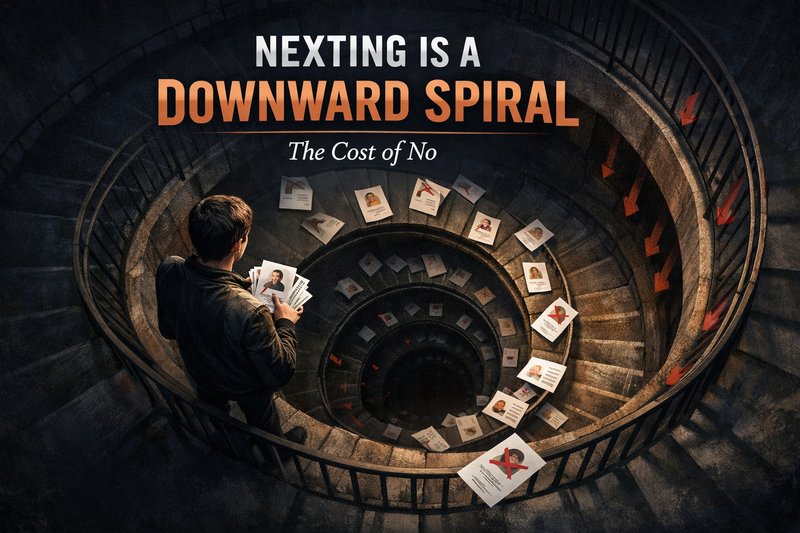
Nexting is a downward spiral.
The shadchan already gave you their best. You said no. They tried again with their second best. You said no. By the third or fourth attempt they’ve moved past anyone they would have suggested on their own. The arithmetic is simple: investing time in someone who won’t say yes to a meeting yields nothing. The careful matchers move their energy to people who will actually show up. You’ve burned through every name a shadchan believed in, and now you’re asking for names nobody believes in.
The phone goes quiet. So you take matters into your own hands. You go to a mixer. You try speed dating. You sign up for an app or a WhatsApp group. You go to a Shabbaton. It feels proactive.
The conditioning came with you.
A singles event. A few hundred people. You walk in, scan the room, and within minutes you’ve already decided: no one here is for me. The reflex does the work before a single conversation happens. Eyes move across faces—too old, too young, wrong look, wrong energy—and the verdict lands quietly. You stay for an hour. You talk politely to people you’ve already dismissed. You leave confirmed in what you already believed.
Speed dating is worse. Eight minutes per person, enough time for the brain to seize on a detail and freeze before the conversation reaches anything real. Online is worse still—the resume problem at industrial scale, a cascade of profiles to reject with a swipe, each one delivering its small hit of relief, the conditioning deepening with every session. The medium changes. The reflex stays.
Nexting is a downward spiral because it is dismissive rather than clarifying. You become an expert in every minuscule facet of what bothers you. Your focus narrows to what you do not want instead of building on what works for you. Each no sharpens the wrong instrument. You get better and better at rejecting and worse and worse at recognizing.

We made the problem the solution.
Yismach AI was built with nexting as an integral constructive piece. Every other system treats the no as a dead end. You reject the suggestion, the shadchan has nothing left, the file closes. Yismach treats the no as data—but only if you’ve actually met the person. A no to a resume teaches the system nothing. A no after a meeting teaches it something real. What you responded to, what fell flat, what mattered more than you expected, what mattered less. The AI takes that feedback and adjusts. Not randomly. Through successive approximation—each suggestion calibrated against everything the system has learned from every previous one.
When a suggestion comes through Yismach, it comes with a detailed explanation of why. Not a score. Not a percentage. A plain-language account of what the shadchan saw, what the AI identified in the overlap between your values and theirs, your life goals and theirs, the things that actually determine whether two people can build something together. You’re not staring at a resume trying to guess whether “enjoys learning” means the same thing to him as it does to you. You’re being told why someone who knows both profiles thinks this is worth a conversation.
But the system cannot learn unless you show up. The AI doesn’t improve from a no to a piece of paper. It improves from a no to a person—from the honest feedback that comes after sitting across from someone for an hour and noticing what worked and what didn’t. Every meeting you skip is a meeting the system can’t learn from. Every resume no is a data point that never was. The suggestions don’t get better by saying no faster. They get better by saying yes, going, and coming back with something real to say.
The secret to its success is that the correlation between what people say they want and what they wind up with is almost zero. Insignificant. The wish list you carry around in your head—the height, the seminary, the neighborhood, the family background—has almost no predictive value for who you will actually be happy with. Research confirms this over and over. So Yismach doesn’t optimize for your stated preferences. It tracks what you actually respond to, your reactions in real time, and navigates toward the factors that correspond to who people wind up with. That’s machine learning. Not matching you to your checklist. Learning what your checklist can’t tell you about yourself.
And you never say anything negative about anyone to a person. It is not lashon hara if only a machine hears it and learns from it. You give honest feedback—what clicked, what didn’t, what surprised you—and the system uses it to refine the next suggestion by successive approximation. No shadchan is burdened with your private reactions. No person on the other side is diminished by your assessment. The feedback stays between you and the algorithm, and the algorithm turns it into a better match.
And there is always a next. Not because we throw names at a wall, but because the network is wide enough and the system deep enough that compatibility doesn’t dead-end with one shadchan’s personal list. The next suggestion isn’t thinner than the last. It’s sharper. Because the system learned something from the meeting you went on, and the one before that, and it’s narrowing toward something real—not by guessing, but by listening to what you told it after you actually showed up.
The no is a reflex. The relief is real. The wisdom is not. Somewhere a shadchan suggested the person they believed in, and you said no on a Tuesday afternoon, and the shadchan had no one else to offer, and the file closed. Yismach doesn’t close the file. It opens the next one. But only if you walk through the door.
[1]Mather, M. & Johnson, M.K. (2000). “Choice-Supportive Source Monitoring: Do Our Decisions Seem Better to Us as We Age?” Psychology and Aging, 15(4), 596–606. See also Mather, M., Shafir, E., & Johnson, M.K. (2000). “Misremembrance of Options Past.” Psychological Science, 11(2), 132–138.
[2]Schwartz, B., Ward, A., Monterosso, J., Lyubomirsky, S., White, K., & Lehman, D.R. (2002). “Maximizing Versus Satisficing: Happiness Is a Matter of Choice.” Journal of Personality and Social Psychology, 83(5), 1178–1197.
[3]Iyengar, S.S., Wells, R.E., & Schwartz, B. (2006). “Doing Better but Feeling Worse: Looking for the ‘Best’ Job Undermines Satisfaction.” Psychological Science, 17(2), 143–150.
[4]Kruglanski, A.W. & Webster, D.M. (1996). “Motivated Closing of the Mind: ‘Seizing’ and ‘Freezing.’” Psychological Review, 103(2), 263–283.