COMMON SENSE IS FOR COMMONERS
Why good judgment is the enemy of love, and what it costs you every time you use it
The person who has thought most carefully about what they want in a spouse has usually been looking the longest.
This is not a coincidence. It is the result. The careful thinking is the problem, not the solution to it — and the relationship between deliberate good judgment and the failure to find someone is not incidental. It is structural. Common sense, applied to love, does not protect you from the wrong person. It protects you from the experience that makes love possible in the first place.
When researchers scanned the brains of people deeply in love and showed them photographs of their beloved, two things happened at the same time. The reward centers — the ventral tegmental area, the caudate nucleus, regions flooded with dopamine, the same circuits that fire for cocaine and gambling — lit up with activity.[1] And the prefrontal cortex went dark.[2]
The prefrontal cortex is not peripheral to the business of judgment. It is where judgment lives. The risk assessment, the critical evaluation of other people, the voice that says something doesn’t add up — that is prefrontal cortex work. When you are genuinely in love with someone, that entire apparatus is neurologically suspended. Not overridden. Not temporarily drowned out. Deactivated, as a matter of mechanism, by the brain itself.
Semir Zeki, who first documented this, described what the scans showed with precision: “the all-engaging passion of romantic love is mirrored by a suspension of judgment or a relaxation of judgmental criteria by which we assess other people.”[3] He was not lamenting a design flaw. He was describing what the design is.
The deactivation goes further still. The regions of the brain responsible for maintaining the distinction between self and other — for knowing where you end and another person begins — also go offline. The unity-in-love that people describe, the feeling that the other person has become part of you, is not metaphor. It is a neurological state produced by the suspension of the mechanism that normally keeps people separate. You cannot love someone while the apparatus that maintains your separateness from them is running. The architecture of love requires it to shut down.
This is the thing common sense cannot survive. Common sense is exactly that apparatus. It is the evaluating, assessing, self-protecting machinery of the mind, and the brain turns it off not despite love but as love’s precondition. The person who insists on keeping it engaged — who stays behind the glass of careful assessment, who maintains the evaluating posture throughout, who never quite stops analyzing — is not being wise. The protection they are maintaining is precisely what prevents the state they are ostensibly trying to reach.
• • •
The sensible dater has a completely coherent set of reasons for every no. He didn’t feel like a potential husband. Something was off. It didn’t make sense to continue when she wasn’t sure. The reasons are never wrong, exactly. They are just never examined.
What common sense is protecting is not, primarily, you from a bad match. It is your ego from exposure. The specific risks common sense guards against in dating are not incompatibility risks. They are the risk of wanting something you might not get. The risk of leaning in and being left. The risk of letting someone see you as you actually are and having them decide that’s not what they were looking for. If you never fully commit, you can never be fully rejected. If you stay behind a managed surface, nothing real can be damaged. You remain, at every stage, in control of the outcome.
These calculations are not irrational. They follow perfectly from the premise that your job is to protect yourself. The problem is the premise. Because the thing being protected — the defended interior, the managed surface, the always-available exit — is the same thing that has to be surrendered for love to be possible at all. The protection guarantees the outcome it was designed to prevent. The person who will not risk being known as they actually are will never be known, and the person who is not known cannot be loved.
This is why the sensation of something being “off” after a date is so often a misleading signal. It is real. It is measuring something. The question is what. Sometimes it is measuring a genuine mismatch. More often it is measuring the discomfort of actual proximity — the specific anxiety produced by an encounter that went somewhere real, where the managed presentation slipped, where something unguarded came out. That discomfort shares the nervous system register with warning. Common sense cannot tell the difference. It only knows the feeling is uncomfortable, and comfort is what it is optimized to protect.
• • •
Forty days before the formation of a person, a Heavenly voice names the one they will marry.[4] The calculation was made before you had preferences to consult, before you developed a list, before you accumulated the experiences that would eventually make you very careful. The match was determined before any of the criteria by which you now evaluate suggestions even existed. Hashem ran the numbers. What He left for you was not the selection process. What He left for you was the clearing of the path.
The primary obstruction on that path, in case after case, is not an imperfect suggestion or an insufficient candidate. It is the elaborate architecture of self-protection that the person has built over years of careful dating — years in which each disappointment produced a new criterion, each near-miss produced a new safeguard, until the accumulated defenses became the very thing standing between the person and what they were looking for.
The Torah’s language for what marriage requires is not the language of careful selection. It is the language of davak: cleave, bond, become inseparable.[5] The same verb used for the attachment to Hashem. Not a considered preference. A total reorientation of the self toward another person — a state that requires the self to become less defended, not more, because the defense and the devotion cannot occupy the same space.
The person waiting to feel certain before committing has the sequence exactly wrong. Certainty about a marriage does not precede the marriage. It is the marriage’s product, built incrementally through the daily choices of two people who have already decided. The commitment is the engine. The certainty is the exhaust. Waiting to feel certain before committing is waiting for something produced only by the commitment you are waiting to feel certain before making.
• • •
The Bereishis Rabbah asks why creation was declared very good rather than merely good, and answers: tov me’od — that is the yetzer hara.[6] Why is the evil inclination very good? Because without it, a man would not build a house, marry a woman, or beget children. The irrational longing, the desire that overrides calculation, the pull that does not wait for the evidence to be complete — that is not the enemy of a good life. It is the condition of one.
Common sense has been telling you that your job is to evaluate carefully, protect your interests, and commit only when the evidence supports it. This is excellent advice for purchasing a car. It is lethal advice for finding a husband.
Love is not blind. Blind suggests a sensory deficit, an impairment, a failure of information reaching the person. That is not what the brain scans show. The information reaches the person. The judgment apparatus that processes information into evaluation is what gets turned off. Not missing its input. Deliberately deactivated. The brain, in the presence of the beloved, silences the very circuitry that common sense is made of — not as a side effect, but as the mechanism by which love operates.
Love is not blind. Love is stupid.
Stupid in the specific, precise, irreplaceable sense of being willing to proceed without the protection of rational evaluation. To lean in before the evidence is complete. To let the judgment go quiet and find out what is there when it does. To be, in the terms common sense uses for itself, a fool.
You have to be willing to be a fool.
Not about everything. Not in all the ordinary domains of life where caution and good sense are exactly right. But specifically here, specifically in the presence of this person, you have to be willing to let the calculating mind go quiet and step forward anyway. The brain already knows this. It is built for it. The prefrontal cortex is designed to stand down.
Common sense will keep you safe. It will keep you alone.
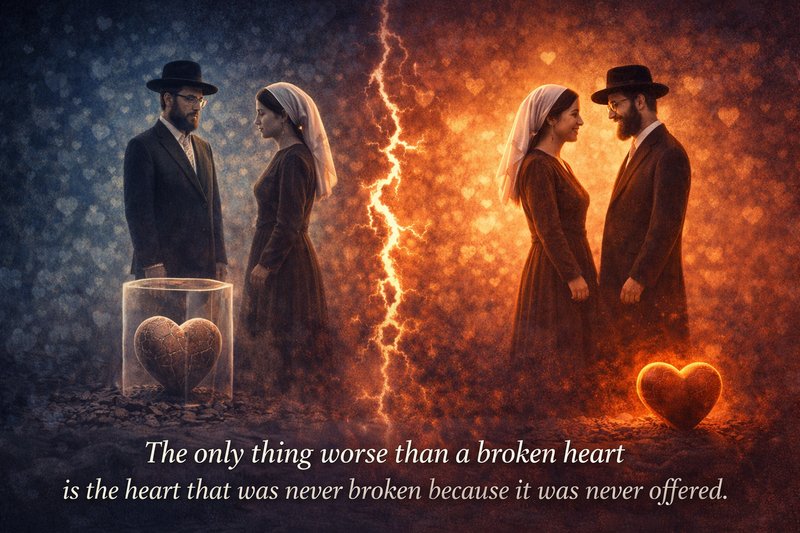
The only thing worse than a broken heart is the heart that was never broken because it was never offered.
Thinking is not feeling and feeling is not thinking.
Who says?
Your brain structure.
You can be logical or you can be married.
[1]Fisher, H.E., Aron, A. & Brown, L.L. (2005). “Romantic Love: An fMRI Study of a Neural Mechanism for Mate Choice.” Journal of Comparative Neurology, 493, 58–62. The VTA and caudate nucleus are the same circuits activated by cocaine, gambling, and other reward stimuli. Fisher’s observation: people who have been rejected in love have been documented to contemplate stalking, homicide, and suicide. This is not the behavior of a system engaged in rational evaluation.
[2]Bartels, A. & Zeki, S. (2000). “The Neural Basis of Romantic Love.” NeuroReport, 11(17), 3829–3834. Brain scans of 17 subjects deeply in love found systematic deactivation in the right prefrontal cortex, bilateral parietal cortex, and temporal cortices — precisely the regions governing judgment, critical assessment, and social evaluation — alongside activation in dopamine-rich reward centers.
[3]Zeki, S. (2007). “The Neurobiology of Love.” FEBS Letters, 581(14), 2575–2579. Zeki’s own characterization: “the all-engaging passion of romantic love is mirrored by a suspension of judgment or a relaxation of judgmental criteria by which we assess other people, a function of the frontal cortex.” The deactivation of the prefrontal-parieto-temporal network — responsible for mentalizing and for distinguishing self from other — is not incidental to love but constitutive of it. To achieve the unity-in-love that lovers seek, the mechanism by which we distinguish self from other must be rendered inactive.
[4]Sotah 2a. Forty days before the formation of an embryo, a Heavenly voice declares: the daughter of so-and-so is designated for so-and-so.
[5]Bereishis 2:24. Ya’azov ish et aviv ve’et imo ve’davak be’ishto. The verb davak — to cleave, to bond, to become inseparable — is used elsewhere in Tanach for the attachment to Hashem (Devarim 11:22). It does not describe a considered preference. It describes a total reorientation of the self.
[6]Bereishis Rabbah 9:7. Tov me’od: this is the yetzer hara. Why is the evil inclination very good? Because without it, a man would not build a house, marry a woman, or beget children.